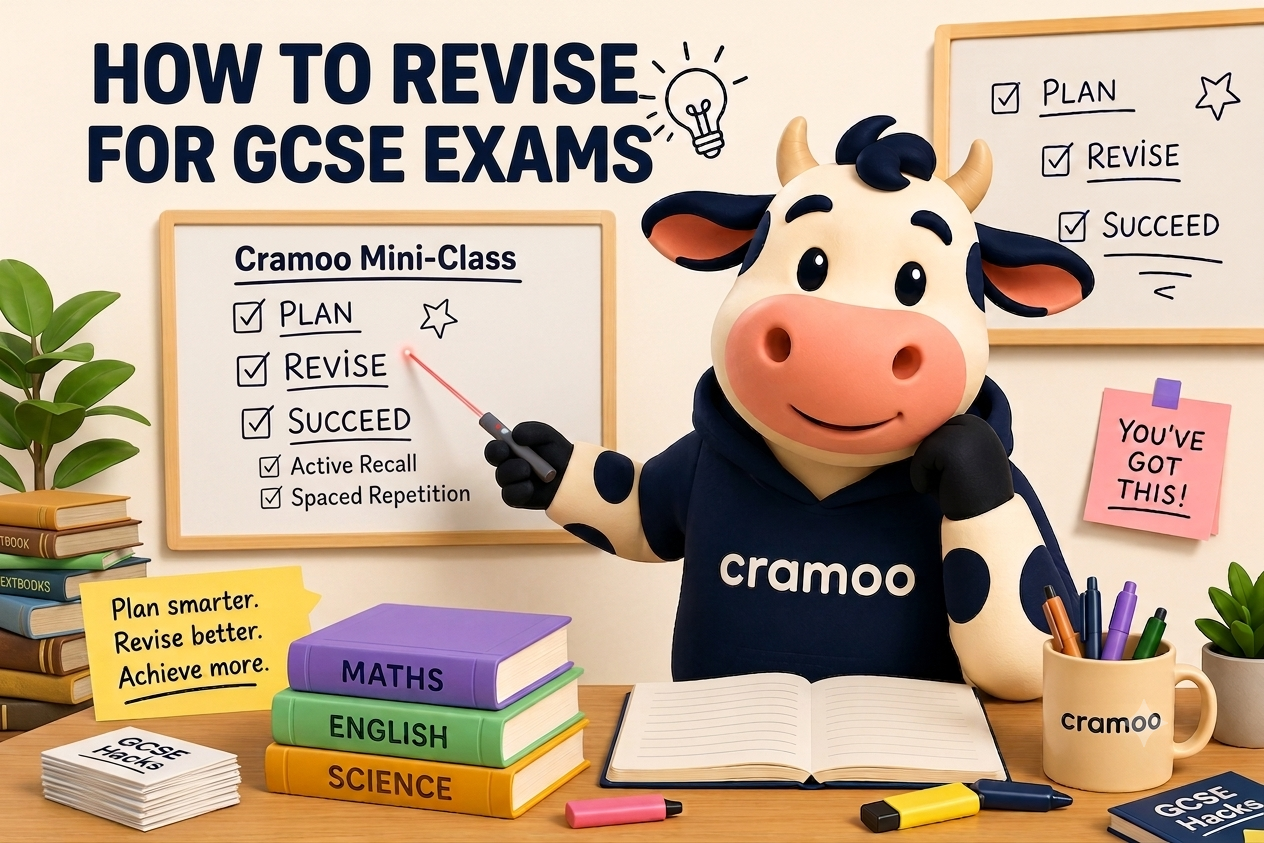
The Complete GCSE Revision Guide
Revision is not just about reading textbooks. This guide covers how to use active recall, past papers, and effective planning to ace your GCSE exams.
The Complete GCSE Revision Guide
GCSE revision is often the first major academic challenge you will face in the UK school system. It is the bridge between general schoolwork and the more specialised world of A-Levels, apprenticeships, or college. Because you are often juggling between eight and twelve different subjects at once, the sheer volume of information can feel overwhelming.
Effective revision is not about how many hours you spend sitting at a desk. It is about how you use that time to move information from your short-term memory into your long-term memory. This guide focuses on evidence-based techniques that reduce stress and improve results.
Why GCSE Revision Strategy Matters
Many students attempt to revise by simply reading through their notes or highlighting key terms in a textbook. Research consistently shows that these are passive methods and are among the least effective ways to learn. Passive revision creates a false sense of security; you feel like you know the material because you recognise it on the page, but you cannot recall it during a high-pressure exam.
Setting a strategy early allows you to build a foundation of knowledge that sticks. Quality GCSE revision ensures you enter the exam hall feeling prepared rather than panicked. It also teaches you the self-discipline and organisational skills that are vital for future academic success.
When to Start Your Revision
The most common mistake is leaving everything until the Easter holidays of Year 11. While you can certainly make progress then, the most successful students start much earlier. Ideal GCSE revision follows a cumulative approach where you review content as you learn it in class throughout Year 10 and Year 11.
Starting your formal, focused revision for the summer exams around February or March gives you enough time to cover every subject twice. This allows for a deeper understanding of complex topics in Science or Maths while giving you time to memorise the necessary quotes for English Literature.
Creating an Effective Revision Timetable
You cannot expect to master your subjects without a plan. A revision timetable prevents the common trap of spending all your time on your favourite subjects while ignoring the ones you find difficult.
To create a successful plan, follow these steps:
- List every topic for every exam board. Each subject is divided into specific modules. You need to know exactly what could come up in the exam.
- Prioritise by difficulty. Use a red-amber-green system. Label topics you struggle with as red, those you are okay with as amber, and those you know well as green. Focus your early revision on the red topics.
- Be realistic. Do not plan to study for ten hours a day. Break your time into 30 or 45-minute blocks with short breaks in between. This is often called the Pomodoro Technique.
- Include variety. Avoid doing five hours of Maths in a row. Your brain stays more engaged if you switch between a creative subject and a technical one.
Active Recall and Spaced Repetition
If you want to excel in your GCSE revision, you must use active recall. This is the process of forcing your brain to retrieve information without looking at your notes. Every time you struggle to remember a fact and then find the answer, you strengthen the neural pathways associated with that information.
Flashcards are a brilliant tool for this. Instead of writing long summaries, write a question on one side and the answer on the other. You can create a free deck to start testing yourself immediately.
Spaced repetition is the partner to active recall. It involves reviewing the same information at increasing intervals. For example, if you learn a concept today, review it tomorrow, then in three days, then in a week, and then in a month. This prevents the forgetting curve and ensures the knowledge is locked in for exam day.
Using Past Papers Effectively
Past papers are arguably the most important resource in your GCSE revision toolkit. They serve three main purposes: they familiarise you with the exam format, they teach you how to manage your time, and they reveal the specific phrasing required by the mark scheme.
Start by doing past papers with your notes open if you lack confidence. As you progress, move towards timed conditions. Pay close attention to the mark scheme. Frequently, students lose marks not because they do not understand the science or history, but because they did not use the specific keywords the examiner was looking for.
Subject-Specific Revision Tips
While general study habits are useful, different subjects require different approaches.
Mathematics and Sciences
These subjects are about application. You cannot revise Maths by reading. You must do practice problems. For Biology, Chemistry, and Physics, focus on understanding the core concepts and then memorising the specific equations and required practicals.
English Literature and History
These subjects require a mix of factual recall and essay-writing skills. For English, curate a list of versatile quotes that can be applied to multiple themes. For History, ensure you have a clear timeline of events and understand the cause-and-effect relationships between different historical periods.
Modern Foreign Languages
Consistent, short bursts of practice are better than long sessions. Use apps or flashcards to build your vocabulary daily, and listen to foreign language podcasts or music to improve your comprehension and accent.
Dealing with Exam Stress
It is normal to feel nervous about your GCSEs. A small amount of stress can actually help you stay focused, but too much can be paralysing. To manage this, ensure you are getting enough sleep. A tired brain cannot retain information effectively.
Physical activity is also vital. Even a twenty-minute walk can clear your head and reduce cortisol levels. Avoid comparing your progress to your friends. Everyone learns at a different pace, and social media often portrays an unrealistic version of how much other people are actually studying.
Common Mistakes to Avoid
- Making your notes too pretty. Spending hours on calligraphy and different coloured highlighters is an aesthetic choice, not a learning one. It often hides the fact that you aren't actually absorbing the information.
- Revising with distractions. If your phone is next to you, you are not focused. Even having it in the same room can reduce your cognitive capacity. Put it in a different room while you work.
- Ignoring the specification. The exam board provides a list of exactly what you need to know. If it is not on the specification, it will not be in the exam. Use the specification as a checklist.
- Not asking for help. If you have been stuck on a concept for twenty minutes, stop. Mark it as an amber or red topic and ask your teacher for a better explanation the next day.
Next Steps for Your Revision
Now that you have an overview of the most effective GCSE revision strategies, it is time to put them into practice. Start by looking at our subject hubs to find specific advice for each of your GCSE units.
You might also find benefit in reading our wider revision tips to refine your daily routine. Remember, consistency is more important than intensity. If you can dedicate a few focused hours each week starting now, you will find the final exam period much easier to manage. If you have already made great Revision material, you can upload your notes to help organize your digital workspace and keep everything in one place.
Revision is a marathon, not a sprint. Take it one topic at a time, stay organised, and use the tools available to you to make the process as efficient as possible.