
GCSE Algebra Revision
Learn how to master GCSE Algebra revision with this guide covering simplifying expressions, solving equations, quadratics, and sequences to boost your maths grade.
GCSE Algebra Revision
Algebra often feels like the final boss of the maths exam. It makes up roughly 30% of the marks on your papers, meaning you cannot afford to skip it. Whether you are aiming for a pass or that elusive Grade 9, mastering the basics and moving on to complex problem-solving is the only way forward.
This guide breaks down the core topics you need to know, from basic expansion to the dreaded quadratic formula, and provides actionable revision tips to help you feel confident on exam day.
Starting with the Basics: Simplifying and Substituting
Before you can solve complex equations, you need to be fluent in the language of algebra. This starts with simplifying expressions. You must be comfortable collecting like terms and applying the laws of indices. Remember, you can only add or subtract terms if they have the same variable and power.
For example, 3x + 5y - x + 2y simplifies to 2x + 7y. However, you cannot combine x and x squared because they represent different values. When multiplying terms, add the powers; when dividing, subtract them. These small rules are the foundation of all GCSE Algebra revision.
Substitution is another quick win. If the question says a = 5 and b = -2, and asks you to find the value of 3a + b squared, pay close attention to negative numbers. Brackets are your best friend here: 3(5) + (-2)^2 becomes 15 + 4, which equals 19. Many students lose marks by forgetting that a negative number squared always results in a positive answer.
Expanding Brackets and Factoring
Expanding and factorising are inverse operations. Expanding is about removing brackets, while factorising is about putting them back in. For single brackets, multiply the term on the outside by everything on the inside.
Double brackets are slightly more involved. Most students use the FOIL method: First, Outside, Inside, Last. If you are asked to expand (x + 3)(x - 5), you get x squared, -5x, +3x, and -15. Combine those middle terms to get x squared - 2x - 15.
Factorising is often where the marks are hidden. For a simple expression like 4x + 12, look for the highest common factor, which is 4. The answer is 4(x + 3). For quadratics, you need to find two numbers that multiply to give the final constant and add to give the coefficient of the middle term. If you find factorising difficult, it is a sign you need to spend more time on your times tables and basic number properties.
Solving Linear and Quadratic Equations
Solving an equation means finding the value of the unknown variable. The golden rule is that whatever you do to one side, you must do to the other. If you move a term across the equals sign, its operation flips. Plus becomes minus, and multiply becomes divide.
Quadratic equations are slightly different because they usually have two solutions. You can solve these by factorising, using the quadratic formula, or completing the square. If a question asks for the answer to two decimal places, that is a massive hint to use the quadratic formula. Memorising this formula is a non-negotiable part of your maths study guides because it is not always provided in the exam.
Rearranging Formulae
Rearranging formulae involves changing the subject of an equation. It uses the same logic as solving equations. If you are asked to make 'w' the subject of P = 2l + 2w, your goal is to get 'w' on its own. You would subtract 2l from both sides (P - 2l = 2w) and then divide the whole thing by 2.
This becomes trickier when the letter you want appears twice. In these cases, you usually need to collect all terms involving that letter on one side and factorise it out. This is a common high-tier question that separates Grade 7 students from Grade 9 students.
Sequences and Graphs
You also need to understand linear and quadratic sequences. For linear sequences, you need to find the 'nth term'. Find the common difference between terms; this becomes the coefficient of n. Then, work out what you need to add or subtract to get to the first term.
Graphs allow you to see algebra in action. You should be able to plot linear equations (y = mx + c) and recognise the shapes of quadratic, cubic, and reciprocal graphs. Understanding that 'm' is the gradient and 'c' is the y-intercept will save you a lot of time during the calculator paper.
How to Revise Algebra Effectively
Algebra is a practical skill. You cannot revise it just by reading through your textbook. You need to pick up a pen and solve problems. Start with easy one-step equations and gradually increase the difficulty.
Using high-quality GCSE revision materials can help you identify which topics you are struggling with. Once you find a weak spot, focus your energy there until you can solve five questions in a row without checking the mark scheme. If you find your notes are a mess, you can always upload your notes to an app that helps you organise them into manageable chunks.
Past papers are the ultimate tool for GCSE revision. They familiarise you with the phrasing used by examiners. Sometimes the hardest part of an algebra question isn't the maths itself, but figuring out what the question is actually asking you to do. Practice helps you translate 'wordy' problems into algebraic equations.
Frequently asked questions
Related reading
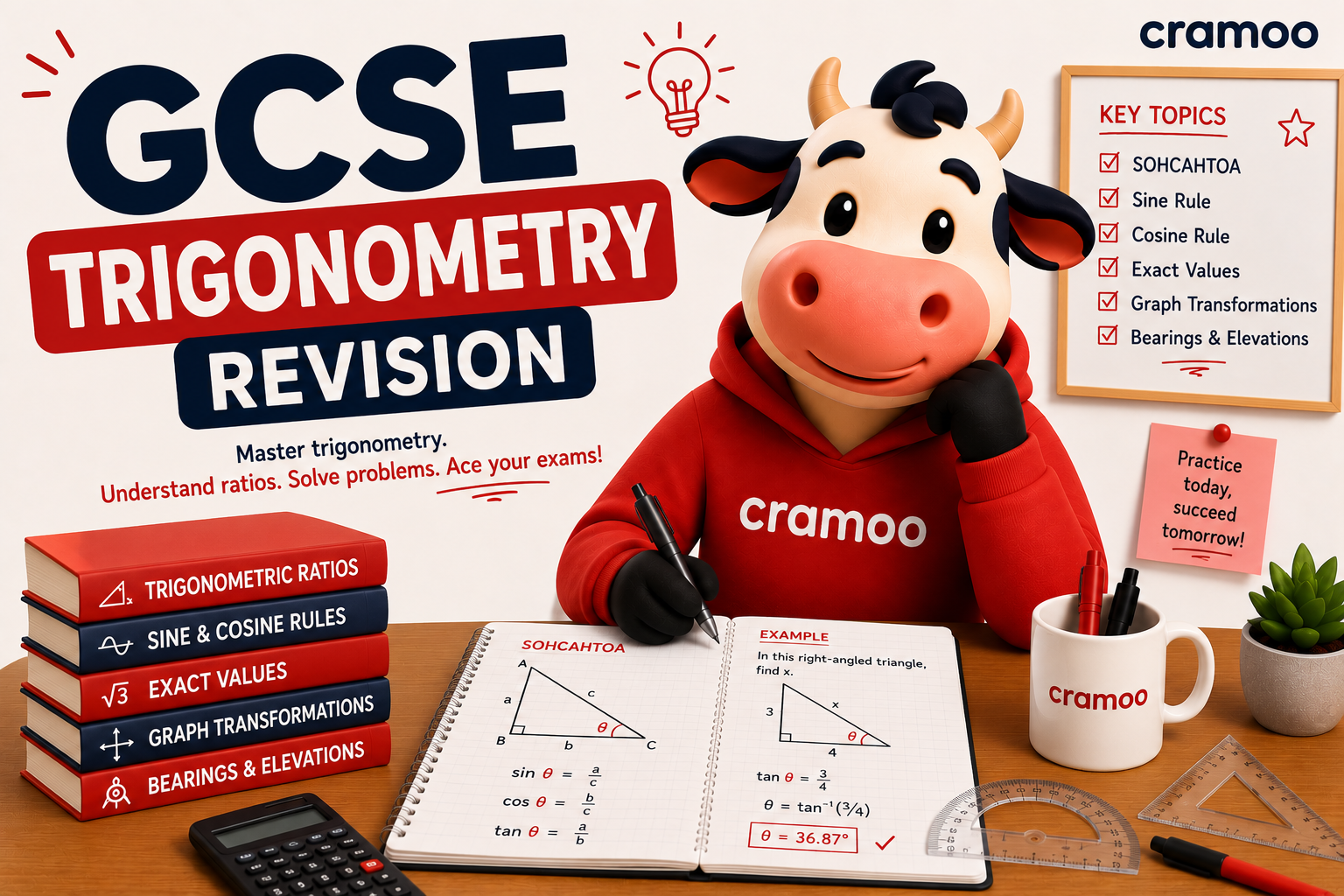
GCSE Trigonometry Revision
Master GCSE Trigonometry with our guide to SOH CAH TOA, the sine and cosine rules, and Pythagoras. Learn how to solve triangle problems and ace your maths exams.
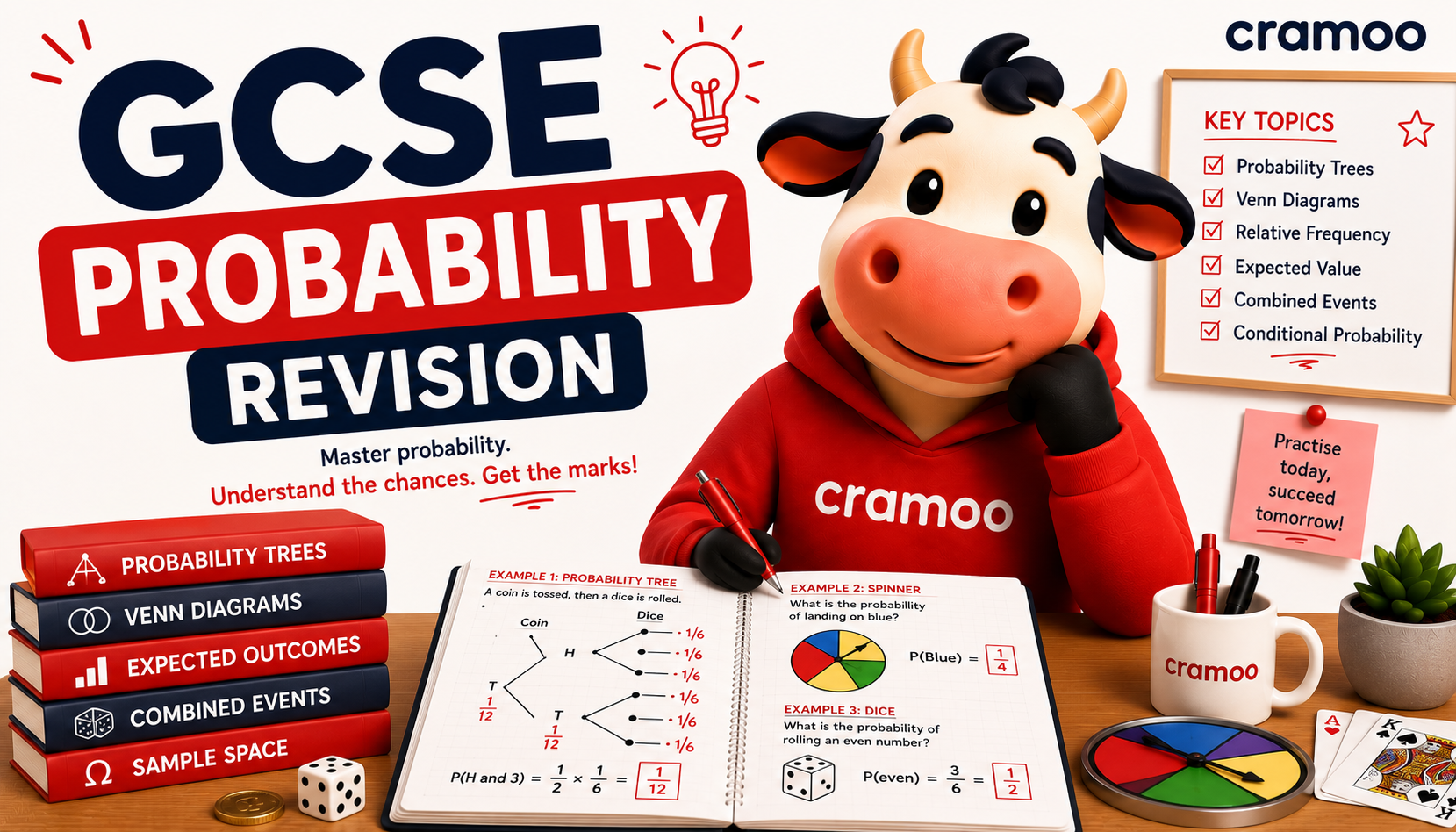
GCSE Probability Revision
Master GCSE Probability with our guide covering scale basics, tree diagrams, Venn diagrams, and independent events to help you ace your Maths exams.
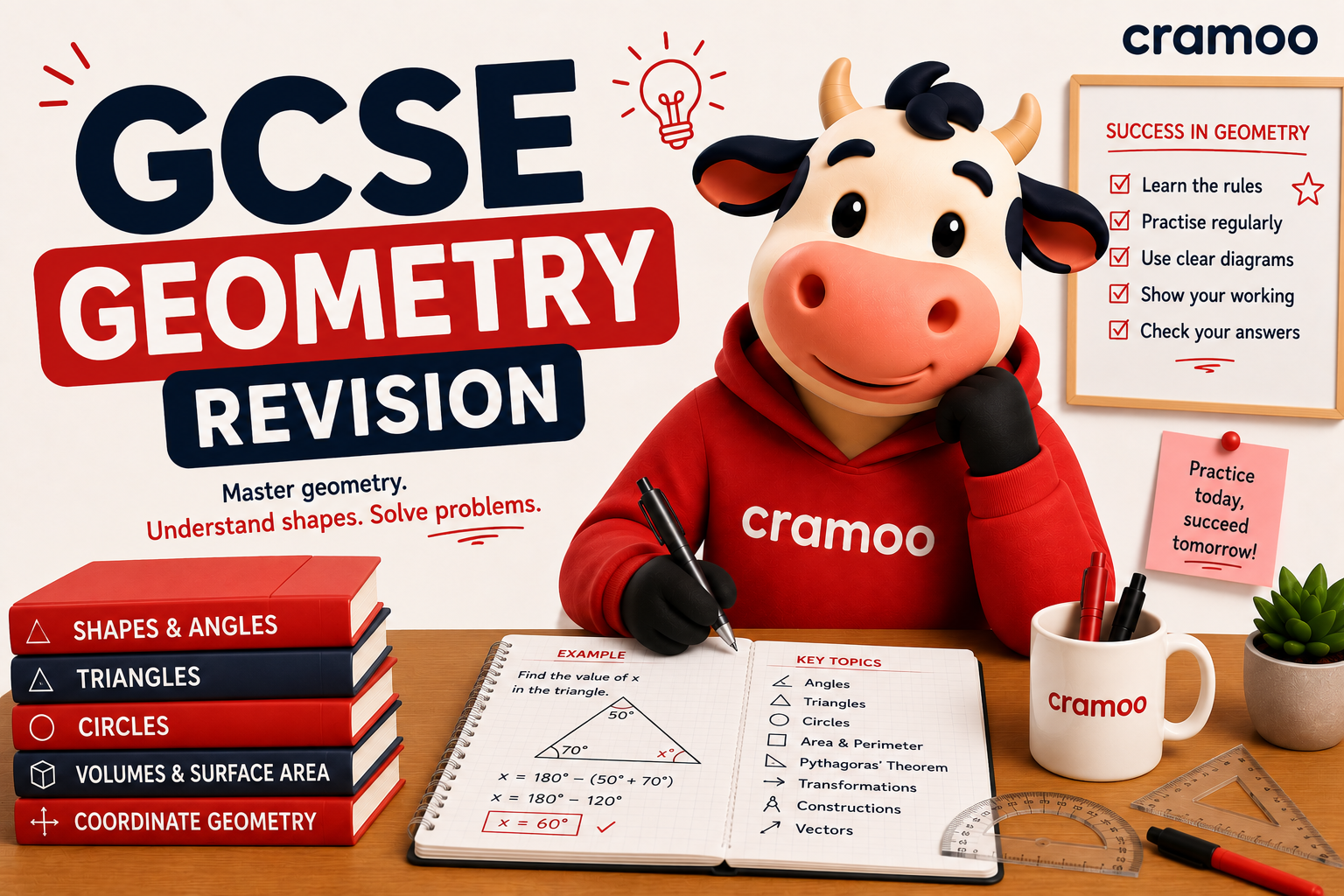
GCSE Geometry Revision
Master every angle, circle theorem, and volume formula with our comprehensive GCSE Geometry revision guide designed for UK students aiming for top grades.
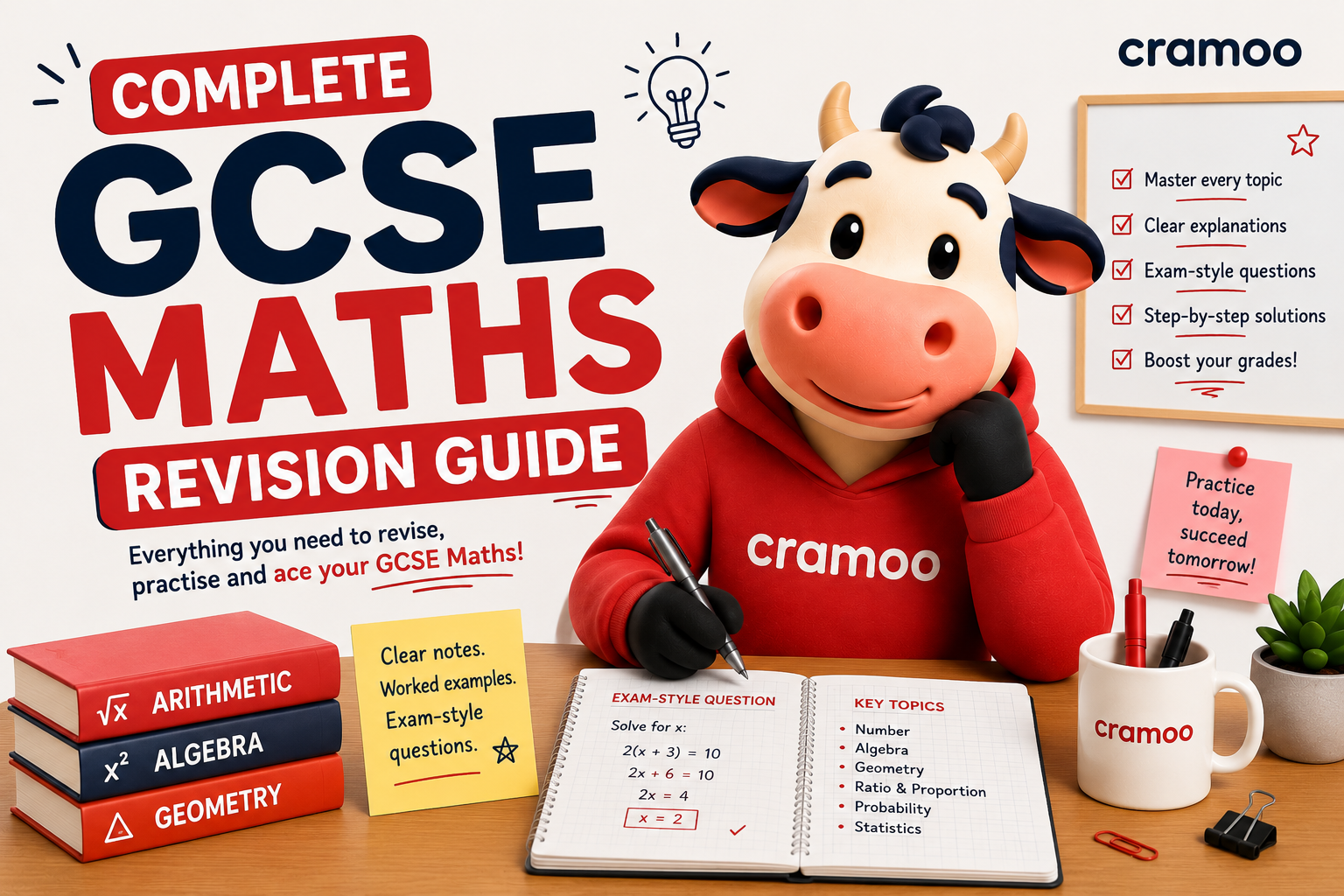
Complete GCSE Maths Revision Guide
Master your exams with this complete GCSE Maths revision guide. We break down the syllabus, provide proven study methods, and show you how to tackle past papers.