
How to Stop Making Silly Mistakes in GCSE Maths
Tired of losing marks to silly errors in your GCSE Maths papers? Discover the specific techniques used by top students to catch mistakes before the timer runs out.
There is nothing more frustrating than opening a marked practice paper to find you have lost marks on a question you actually knew how to do. These are 'silly mistakes' — dropping a minus sign, misreading 6 as 0, or forgetting to square a number.
In a 9-1 GCSE Maths paper, the difference between a Grade 4 and a Grade 5, or a Grade 7 and a Grade 8, is often fewer than five marks. Eliminating unforced errors is the fastest way to boost your score without learning new content. This guide covers how to identify these errors and the specific habits you need to build to stop them happening.
The Three Types of GCSE Maths Exam Mistakes
To stop making mistakes, you first need to categorise them. Look back at your recent mock papers and mark each wrong answer with one of these three labels:
- Process Errors: You understood the topic but messed up the execution (e.g., adding 7 and 5 to get 13).
- Reading Errors: You solved the wrong problem (e.g., finding the area when the question asked for the perimeter).
- Knowledge Gaps: You simply did not know the formula or method required.
If most of your lost marks are in categories one and two, you have a 'silly mistake' problem. The good news is that these are entirely fixable with better exam technique. For category three, you should refer to The Complete GCSE Revision Guide to brush up on your core knowledge.
Write Every Step Down
Many students try to do simple calculations in their head to save time. This is a trap. When you perform mental arithmetic under exam pressure, your brain is more likely to glitch.
Writing down your working serves two purposes. Firstly, it allows the examiner to give you 'method marks' even if your final answer is wrong. Secondly, it creates a 'trail' that makes checking your work much easier.
The Worked Example Trick
If a question asks you to solve: 3(x + 4) = 27
Common mistake: 3x + 4 = 27 3x = 23 x = 23/3 (Result: 0 marks for a wrong first step)
Correct process: 3x + 12 = 27 (Show you expanded the bracket) 3x = 27 - 12 (Show you subtracted 12) 3x = 15 x = 5
By writing every step, you reduce the cognitive load on your brain. You aren't trying to remember the previous number while doing the next calculation.
Use the Reverse Check Method
Instead of just re-reading your work, which often leads to your brain skipping over the same error twice, use a different mathematical operation to verify the answer. This is one of the most effective revision tips for mathematicians.
- Inverse Operations: If you solved an equation and got x = 5, plug that 5 back into the original equation. Does it balance? If not, you've made a mistake.
- Estimation: Before you start a calculation, guess the approximate answer. If you are multiplying 19.5 by 4.1, your answer should be close to 20 x 4 = 80. If your calculator says 8.0 or 800, you know a decimal point has gone rogue.
- Alternative Methods: If you solved a quadratic by factorising, try using the quadratic formula to see if you get the same roots.
Common Pitfalls in Calculator Papers
Modern calculators are brilliant, but they only do what you tell them. A very common error in GCSE maths exam mistakes involves negative numbers and powers.
If you type -3² into many scientific calculators, the output will be -9. However, mathematically, (-3)² is 9. The calculator follows BIDMAS and squares the 3 before applying the negative sign. To avoid this, always put negative numbers in brackets when squaring them: (-3)².
Another frequent error is having your calculator in the wrong mode. Ensure your calculator displays 'D' for degrees at the top of the screen. If it shows 'R' (radians) or 'G' (gradients), your trigonometry answers for sine, cosine, and tangent will be completely wrong.
The 'Final Read' Technique
Before you move on to the next page, perform a five-second 'Final Read' of the question. Check for these three things:
- Units: Did the question ask for the answer in metres, but you gave it in centimetres? Did you include units at all?
- Rounding: Does the question specify 'two decimal places' or 'three significant figures'? This is a very common way to lose a final mark on high-tier papers.
- The Actual Question: Did you find 'x' when the question asked for the coordinates of point P? Did you find the probability of 'not' picking a red marble?
Creating Active Revision Materials
To stop these errors from becoming habits, you need to train your brain to spot them. Use your practice papers to create a free deck of flashcards specifically for your 'favourite' mistakes.
On the front of the card, write: "What is the danger in squaring a negative number on a calculator?" On the back, write: "Always use brackets, e.g., (-5)²."
Or, front: "Checklist for every geometry question." Back: "1. Are the units consistent? 2. Is the answer rounded correctly? 3. Does the answer look physically possible?"
You can also upload your notes to digital tools to help organise these reminders into a coherent study plan.
Managing Your Time to Allow for Checking
You cannot catch silly mistakes if you are rushing until the final second. Aim to finish the paper with 10 to 15 minutes to spare.
If you hit a question that looks impossible, don't spend 10 minutes staring at it. Move on, secure the easy marks, and come back to it later. A common cause of GCSE maths exam mistakes is the 'panic spiral' that happens when a student spends too long on one difficult question and then has to rush the rest of the paper.
When you do go back to check, don't just look at your work. Re-read the question from scratch. Sometimes, our brains see what we think is there rather than what is actually printed on the page. By reading it fresh, you are more likely to notice if you misread a number or a sign.
Summary of Daily Habits
Improving your accuracy isn't something that happens only on exam day. It starts during your weekly homework and GCSE revision.
- Use a clear, dark pen so you don't misread your own handwriting.
- Keep one digit per square if you use squared paper.
- Align your decimal points vertically when adding or subtracting.
- Highlight or underline keywords in the question (e.g., 'integer', 'inclusive', 'reciprocal').
By treating every practice question with the same rigour as a final exam, you build the 'muscle memory' needed to stay accurate under pressure.
Frequently asked questions
Related reading
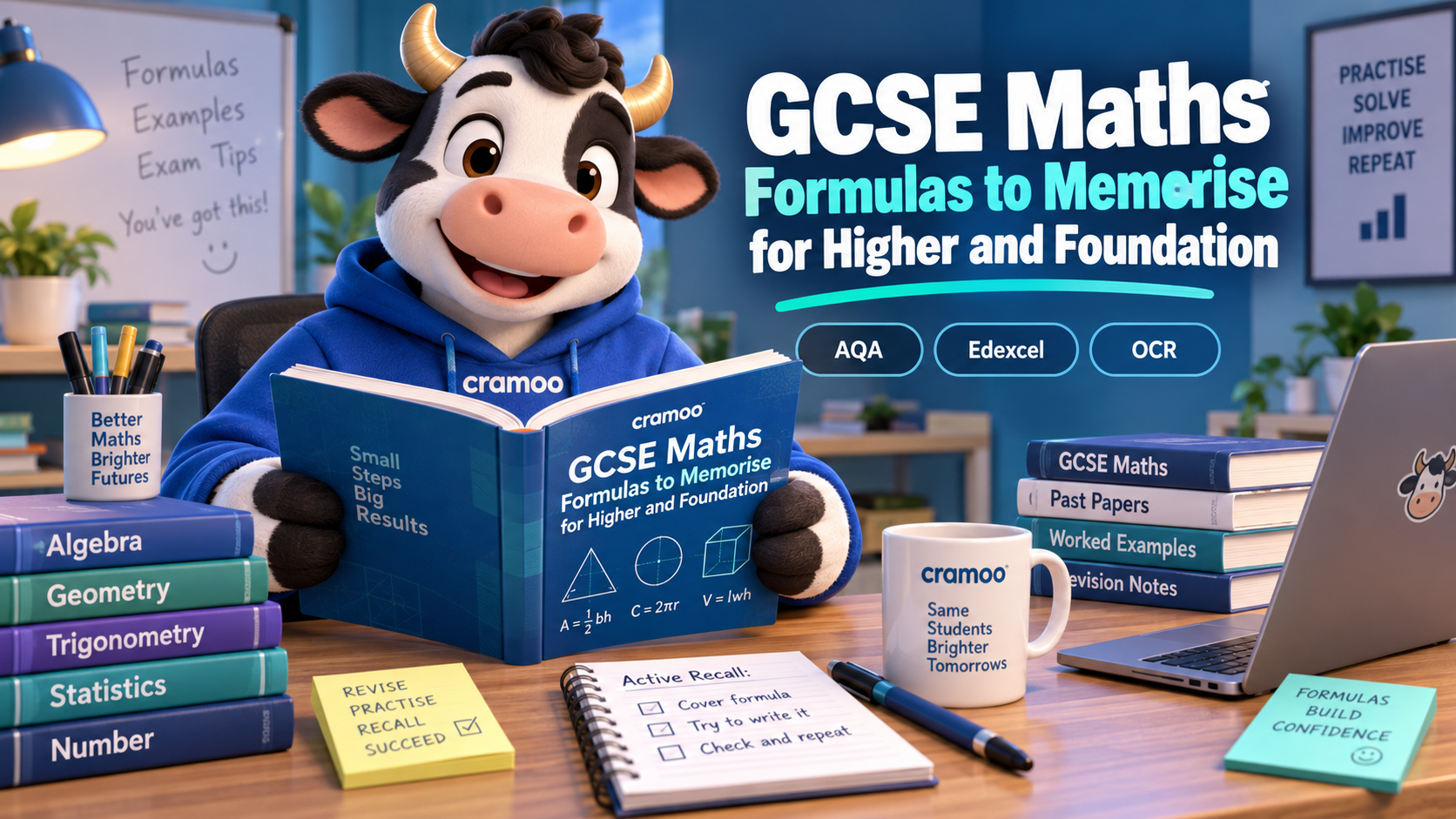
GCSE Maths Formulas to Memorise for Higher and Foundation
A comprehensive breakdown of all GCSE maths formulas you must memorise for AQA, Edexcel, and OCR exams, featuring worked examples and active recall tips.
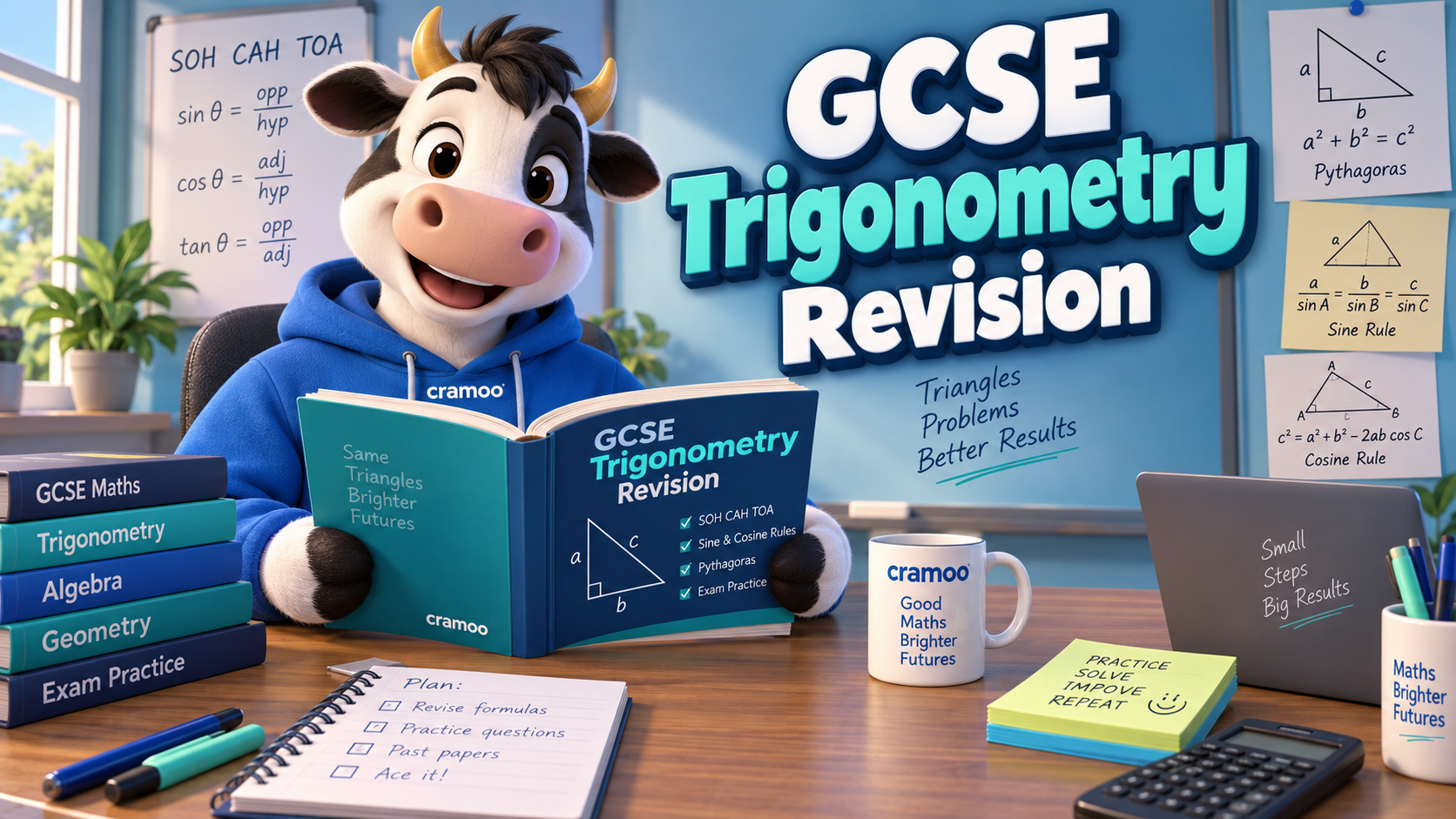
GCSE Trigonometry Revision
Master GCSE Trigonometry with our guide to SOH CAH TOA, the sine and cosine rules, and Pythagoras. Learn how to solve triangle problems and ace your maths exams.
GCSE Probability Revision
Master GCSE Probability with our guide covering scale basics, tree diagrams, Venn diagrams, and independent events to help you ace your Maths exams.
GCSE Geometry Revision
Master every angle, circle theorem, and volume formula with our comprehensive GCSE Geometry revision guide designed for UK students aiming for top grades.