
GCSE Maths Formulas to Memorise for Higher and Foundation
A comprehensive breakdown of all GCSE maths formulas you must memorise for AQA, Edexcel, and OCR exams, featuring worked examples and active recall tips.
Walking into your GCSE maths exam without knowing your formulas is like trying to build a flat-pack wardrobe without the instructions. While exam boards like AQA, Edexcel, and OCR have provided formula sheets in recent years, you cannot rely on them forever, and knowing them by heart saves precious time during the paper.
Mathematical fluency comes from being able to recall a formula instantly so you can focus on the actual problem-solving. This guide covers the essential formulas for both Foundation and Higher tiers, along with practical ways to make them stick.
Area and Perimeter Formulas
You are expected to know the area formulas for all basic 2D shapes. These often appear in the first half of the paper and are essential for more complex geometry questions later on.
The Basics
- Rectangle: Area = length × width
- Triangle: Area = 0.5 × base × height
- Parallelogram: Area = base × perpendicular height
- Trapezium: Area = 0.5(a + b)h (where a and b are the parallel sides)
Circles
Circles are a frequent source of lost marks. Remember that the radius is half the diameter.
- Circumference: C = πd or C = 2πr
- Area of a Circle: A = πr²
Study Tip: To remember which is which, look at the units. Area is always measured in units squared (like cm²), and the formula for area includes the radius squared (r²).
Algebra and Graphs
Algebra makes up a huge percentage of the GCSE maths marks. If you are sitting the Higher tier, the quadratic formula is a non-negotiable.
Linear Graphs
The equation of a straight line is y = mx + c.
- m is the gradient (change in y / change in x).
- c is the y-intercept (where the line crosses the vertical axis).
The Quadratic Formula (Higher Tier Only)
When a quadratic equation is in the form ax² + bx + c = 0, you find x using: x = [-b ± √(b² - 4ac)] / 2a
Worked Example: Solve 2x² + 7x + 3 = 0
- Identify a=2, b=7, c=3.
- Substitute: x = [-7 ± √(7² - 4(2)(3))] / (2 * 2)
- Simplify: x = [-7 ± √(49 - 24)] / 4
- x = [-7 ± √25] / 4
- x = (-7 + 5)/4 = -0.5 OR x = (-7 - 5)/4 = -3
Pythagoras and Trigonometry
These formulas are used to find missing sides and angles in triangles. You should include these in your GCSE revision plan as they appear in both calculator and non-calculator papers.
Pythagoras' Theorem
For a right-angled triangle: a² + b² = c² Remember that 'c' must always be the longest side (the hypotenuse).
Trigonometry (SOH CAH TOA)
- Sin(θ) = Opposite / Hypotenuse
- Cos(θ) = Adjacent / Hypotenuse
- Tan(θ) = Opposite / Adjacent
For Higher tier students, you also need the Sine and Cosine rules for non-right-angled triangles:
- Sine Rule: a/sinA = b/sinB = c/sinC
- Cosine Rule: a² = b² + c² - 2bc cosA
- Area of any Triangle: 1/2 ab sinC
Compound Measures
Compound measures are used in real-world contexts and are standard marks in The Complete GCSE Revision Guide. Use the triangle method to rearrange these easily.
- Speed: Speed = Distance / Time
- Density: Density = Mass / Volume
- Pressure: Pressure = Force / Area
Worked Example: A car travels 150 miles in 3 hours. What is its average speed? Speed = 150 / 3 = 50 mph. If the question asks for the answer in metres per second, you must convert the units before or after the calculation.
Statistics and Probability
While often seen as easier, these formulas are easy to mix up under exam pressure.
- Mean: Total sum of data / Number of values
- Probability of an event: Number of successful outcomes / Total number of possible outcomes
- Relative Frequency: Number of times an event occurs / Total number of trials
How to Memorise These Formulas Effectively
Reading a list of formulas is the least effective way to learn them. Instead, use active recall methods found in popular revision tips.
Use Flashcards
Put the name of the formula on one side (e.g., "Area of a Trapezium") and the formula on the other. Use a digital tool or physical cards to test yourself daily. You can create a free deck to track which ones you keep getting wrong.
The 'Brain Dump' Method
At the start of every practice paper or study session, take a blank piece of paper and write down every formula you can remember. Check against a master list and highlight the ones you missed. Do this every day for a week, and you will find you rarely forget them.
Apply Them Immediately
Do not just learn the formula in isolation. As soon as you learn the Sine Rule, complete five different practice questions that require it. This builds the connection in your brain between the visual shape of a triangle and the formula required to solve it. Using study guides that offer tiered practice questions can help bridge this gap.
Summary for Exam Day
Check your specific exam board (AQA, Edexcel, or OCR) to see if they are providing a formula sheet for your specific exam year. Even if they are, memorising the basics like speed, area, and Pythagoras will give you more time to tackle the difficult multi-step problems at the end of the paper. Just like memorising GCSE Chemistry Equations, being prepared for maths is about repetition and practice.
Frequently asked questions
Related reading
How to Stop Making Silly Mistakes in GCSE Maths
Tired of losing marks to silly errors in your GCSE Maths papers? Discover the specific techniques used by top students to catch mistakes before the timer runs out.
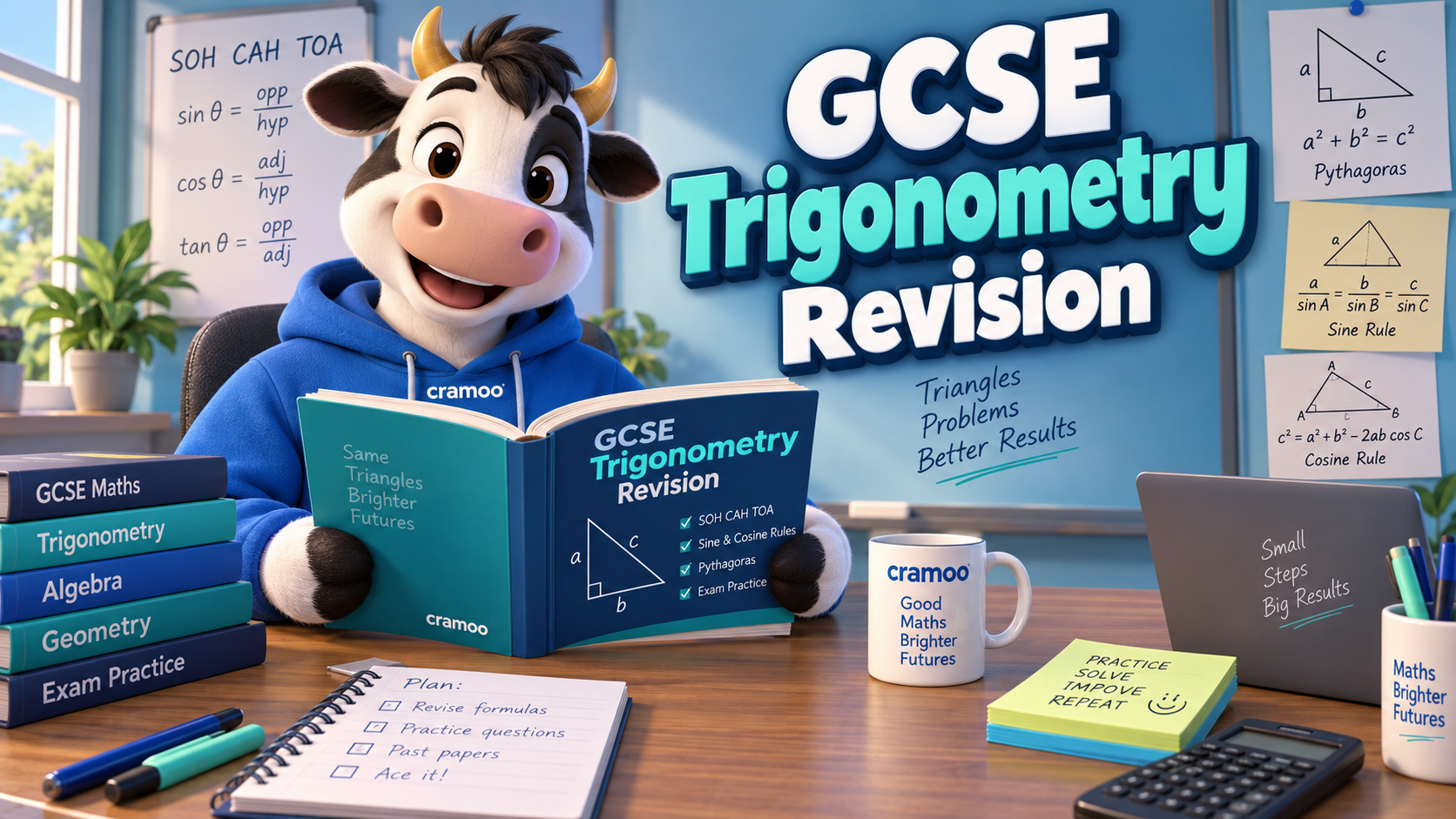
GCSE Trigonometry Revision
Master GCSE Trigonometry with our guide to SOH CAH TOA, the sine and cosine rules, and Pythagoras. Learn how to solve triangle problems and ace your maths exams.
GCSE Probability Revision
Master GCSE Probability with our guide covering scale basics, tree diagrams, Venn diagrams, and independent events to help you ace your Maths exams.
GCSE Geometry Revision
Master every angle, circle theorem, and volume formula with our comprehensive GCSE Geometry revision guide designed for UK students aiming for top grades.