
How to Revise for A-Level Exams
The revision techniques that actually work at A-Level, and the comfortable ones that quietly waste your time.
How to Revise for A-Level Exams
A-Level revision rewards a different set of habits to GCSE. The content is deeper, the papers ask you to apply ideas to unfamiliar situations, and there is simply more of it per subject. The good news is that a small number of techniques do almost all of the heavy lifting — and none of them involve rewriting your notes in nicer handwriting.
Here are ten methods that consistently produce results, and how to fit them into a normal school week.
1. Turn the Specification Into a Checklist
Your exam board publishes a specification listing every assessable point in the course. Print it, tick off what you can explain from memory, and highlight what you cannot. Everything you revise from now on comes off that list, which removes the "what should I even do tonight?" problem entirely.
2. Use Active Recall, Not Rereading
Rereading a chapter feels productive and does almost nothing. Instead, close the book and write down everything you can remember about the topic on a blank sheet — this is often called blurting. Then compare against your notes and add the missing material in another colour.
The bits you missed are your revision list for tomorrow. Repeat until the page comes out complete.
3. Space Your Reviews
Reviewing a topic once teaches you it for a week. Reviewing it after one day, three days, a week, and then a fortnight teaches it to you for the year. Flashcards are the easiest way to run this schedule without tracking it manually — upload your notes to Cramoo and it will build the deck for you.
4. Interleave Topics Within a Session
Do not spend three hours on one chapter. Mix two or three topics from the same subject, or two subjects, in a single session. Switching feels harder and produces measurably better retention because your brain has to select the right method rather than repeating one on autopilot.
5. Practise With Past Papers Under Timed Conditions
From Easter onwards, one full timed paper per subject per week should be non-negotiable. Sit it without notes, to time, in one go. Then mark it against the official mark scheme and record:
- the mark you lost
- whether you lost it on knowledge, technique, or timing
- what you will do differently next time
That log is more valuable than the score itself. Read How A-Levels Are Marked to understand what markers are instructed to look for.
6. Learn the Command Words
"Describe", "explain", "analyse", "evaluate", "discuss", "to what extent" — each demands a specific structure and a specific number of developed points. Students routinely lose whole bands of marks for writing a good description in response to an evaluate question.
Make a single page per subject listing each command word, what it requires, and how many marks it usually carries.
7. Build Example, Quotation and Case-Study Banks
For essay subjects, marks come from specific, well-chosen evidence. Build a one-page bank for each topic: three quotations, three statistics, or three case studies, each with a note on what argument it supports. Learning ten flexible examples beats half-remembering thirty.
8. Explain It Out Loud
If you cannot explain a concept in plain language without notes, you do not know it well enough for a six-mark application question. Teach a topic to a friend, a family member, or an empty room. The moment you stumble is the moment you have found the gap.
9. Target Your Weakest Topics First
The temptation is to revise what you enjoy. Resist it. Use your traffic-light checklist and spend the first block of every session on a red topic while your concentration is highest, then reward yourself with something you find easier.
10. Review Actively in Short Daily Bursts
Ten minutes of flashcards every day beats two hours on a Sunday. Short daily reviews keep material accessible with almost no willpower cost, which matters enormously during Year 13 when coursework, UCAS and mocks all land at once.
Fitting It Into a Real Week
A workable weekday pattern for Year 13 during term time looks like this:
- 10 minutes of flashcard review in the morning
- two 45-minute blocks after school, each on a different subject
- one 20-minute review of what you covered that day before bed
At weekends, add one timed past-paper session and one longer block on your weakest subject. Our A-Level Revision Timetable guide shows how to lay this out across a full week, and How Much Should You Revise for A-Levels? covers realistic hour targets.
Subject Notes
- Maths: revision is question practice. Work by topic first, then whole papers — see the A-Level Maths hub.
- Sciences: definitions must be word-perfect, and required practicals come up more often than students expect. Start with Biology or Chemistry.
- Humanities and social sciences: plan essays in five minutes rather than writing them in full every time; you will get through five times as much practice.
Common Mistakes to Avoid
- Making beautiful notes instead of testing yourself.
- Using another exam board's past papers — check yours in A-Level Exam Boards Explained.
- Leaving all past papers until the final two weeks.
- Revising for four hours with your phone next to you rather than 90 focused minutes without it.
- Skipping sleep. Memory consolidates overnight; an all-nighter costs you more than it buys.
Where to Start Today
Pick one subject, traffic-light the specification, and turn your first red topic into flashcards. Then review them for ten minutes tomorrow morning. That single loop — identify the gap, make the cards, review daily — is the whole of effective A-Level revision.
Turn your notes into a deck automatically with Cramoo, or browse more guides in the A-Level hub.
Frequently asked questions
Related reading
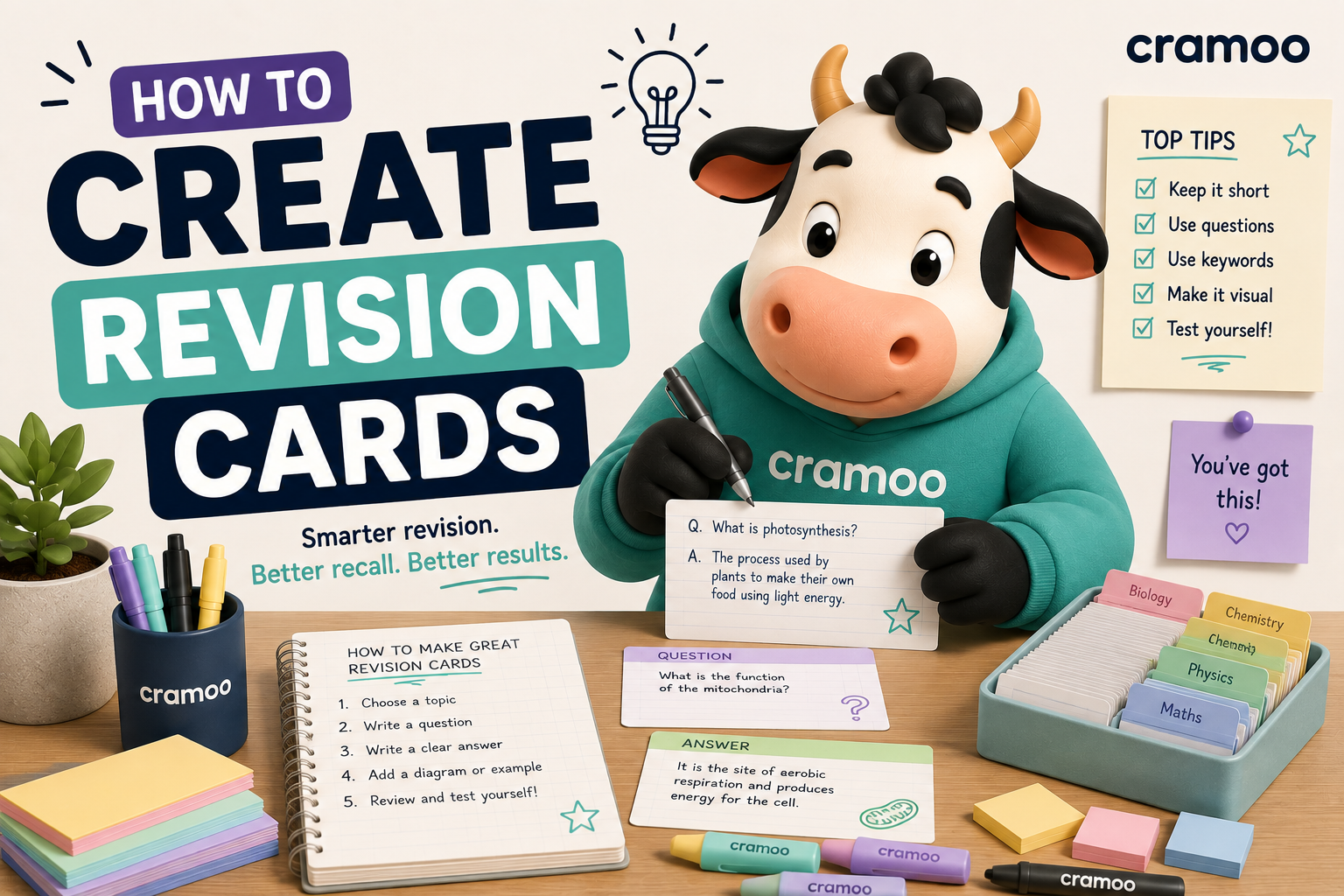
How to create Revision Cards
Discover the most effective ways to create revision cards using active recall and spaced repetition to transform your exam preparation and boost your grades.
How to Revise for GCSE Exams
Learn how to revise for GCSE exams using evidence-based techniques like active recall and spaced repetition to improve memory retention and boost your grades.