
GCSE Geometry Revision
Master every angle, circle theorem, and volume formula with our comprehensive GCSE Geometry revision guide designed for UK students aiming for top grades.
GCSE Geometry Revision
Geometry makes up a significant chunk of your GCSE Maths papers, often accounting for roughly 20% of the total marks. Whether you are aiming for a grade 4 or a grade 9, mastering shapes, angles, and measures is essential. This guide breaks down the core topics you need to know, from the basic properties of triangles to the more complex circle theorems that often appear at the end of the Higher tier paper.
Basic Angle Rules and Polygons
Before you can tackle complex trigonometry, you need to be confident with the fundamental angle rules. These are the building blocks for almost every geometry question. You should know that angles on a straight line add up to 180 degrees, while angles around a point add up to 360 degrees.
When it comes to parallel lines, look out for 'Z' angles (alternate angles), 'F' angles (corresponding angles), and 'C' angles (co-interior angles). Remember that alternate and corresponding angles are equal, while co-interior angles sum to 180 degrees. In your exam, always state the geometric reason for your answer. Markers cannot give you full marks if you calculate the angle correctly but fail to name the rule.
For regular polygons, you might be asked to find the interior or exterior angles. The exterior angles of any polygon always sum to 360 degrees. To find the exterior angle of a regular polygon, simply divide 360 by the number of sides. To find the interior angle, subtract the exterior angle from 180.
Area, Perimeter, and Volume
Calculating the size of shapes is a core part of GCSE Geometry Revision. You must memorise the formulas for common 2D shapes like parallelograms, triangles, and trapezia. For a trapezium, the formula is 1/2(a+b)h, where 'a' and 'b' are the parallel sides and 'h' is the vertical height.
When moving into 3D shapes, you need to distinguish between prisms and non-prisms. The volume of any prism is simply the area of its cross-section multiplied by its length. For spheres, cones, and pyramids, the formulas are usually provided on the exam formula sheet, but you must be comfortable substituting values into them and working backwards to find a missing radius or height.
Pythagoras and Trigonometry
Pythagoras' Theorem (a² + b² = c²) only applies to right-angled triangles. It is used to find a missing side when you already know two others. If you are looking for the hypotenuse (the longest side), you add the squares of the other two sides. If you are looking for a shorter side, you subtract.
Trigonometry (SOH CAH TOA) takes this a step further by involving angles. For the Foundation tier, you only need to know right-angled trigonometry. For the Higher tier, you will also need to master the Sine Rule, the Cosine Rule, and the formula for the area of a triangle (1/2 ab sin C). These are vital for non-right-angled triangles. A common exam trick is to combine trigonometry with bearings or 3D shapes, so practice multi-step problems whenever you can.
Circle Theorems
Circle theorems are often the most dreaded part of the Higher tier paper, but they are predictable once you recognise the patterns. There are several key rules to learn:
- The angle at the centre is twice the angle at the circumference.
- Angles in the same segment are equal.
- The angle in a semicircle is always 90 degrees.
- Opposite angles in a cyclic quadrilateral sum to 180 degrees.
- The alternate segment theorem.
- Tangents from a point to a circle are equal in length.
When revising these, draw them out by hand multiple times. Highlighting the relevant parts of the circle can help you spot which theorem applies in a complex diagram.
Transformations and Vectors
Transformations involve moving or changing a shape on a coordinate grid. You need to be able to perform and describe four types:
- Reflection: You need a mirror line (e.g., x = 2 or y = x).
- Rotation: You need an angle, a direction (clockwise or anti-clockwise), and a centre of rotation.
- Translation: You use a vector to describe the movement left/right and up/down.
- Enlargement: You need a scale factor and a centre of enlargement. Note that fractional scale factors make the shape smaller, and negative scale factors flip the shape on the opposite side of the centre.
Vectors describe a movement from one point to another. In the Higher tier, you will deal with vector geometry proofs. The key here is to find different paths to the same point and show they are equivalent or multiples of one another. This often links back to your work on ratios.
How to Study Effectively
Geometry is a visual subject. Reading a textbook is rarely enough to make the information stick. You need to draw diagrams and practice past paper questions. Start by looking at the Complete GCSE Maths Revision Guide to see how geometry fits into the broader syllabus. If you find the algebra involved in solving geometry problems difficult, you might want to spend some time on GCSE Algebra Revision to sharpen those skills.
Use flashcards to memorise your formulas and circle theorems. You can create a free deck to test yourself on things like the volume of a cylinder or the interior angle of a hexagon. Consistent, short bursts of testing are far more effective than one long cramming session the night before the exam. If you have your own notes, you can also upload your notes to create custom study materials tailored to your specific exam board.
Check out our other study guides to ensure you are covering all the necessary topics for your GCSE revision. Staying organised and using a variety of resources will help you feel much more confident when you walk into the exam hall.
Frequently asked questions
Related reading
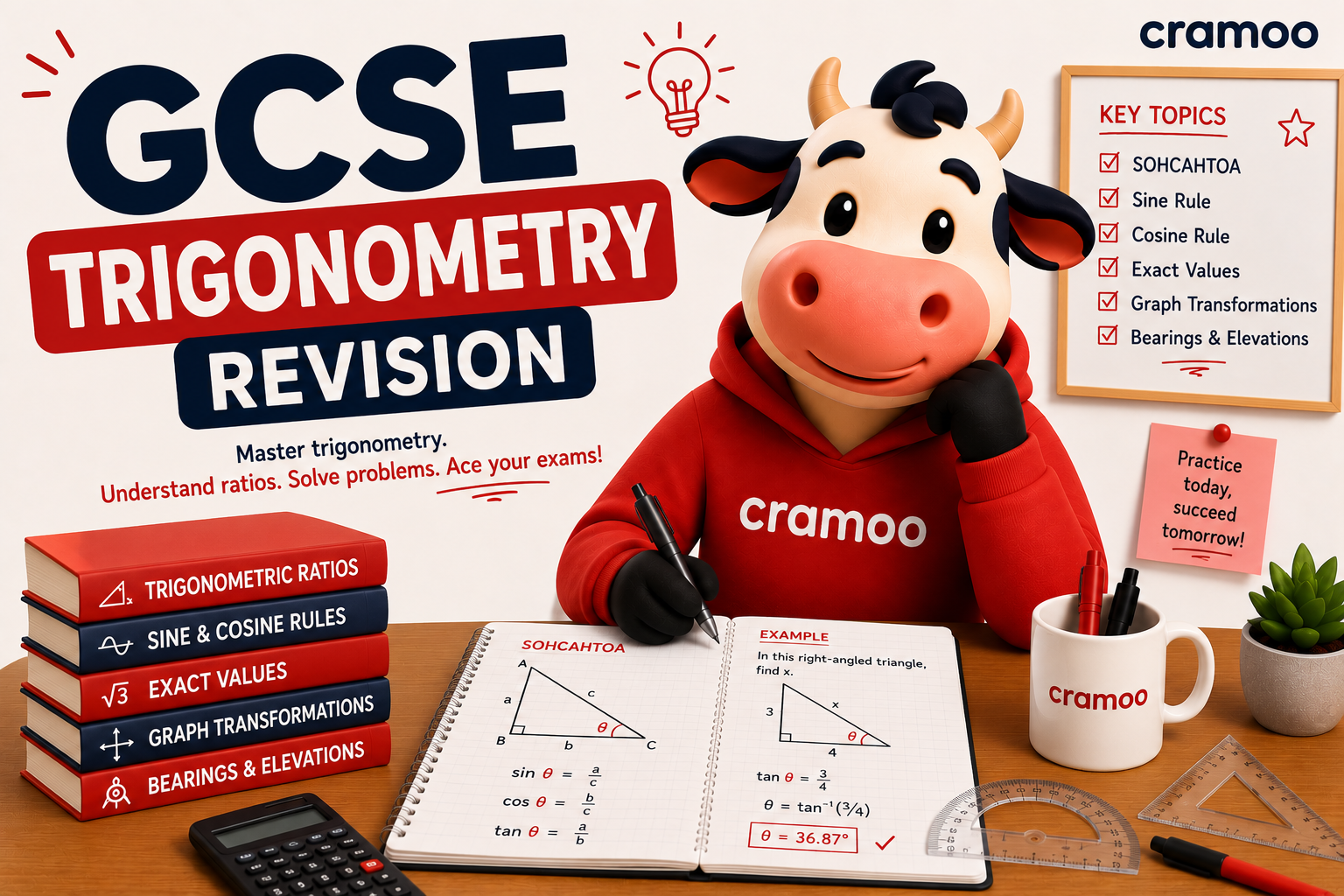
GCSE Trigonometry Revision
Master GCSE Trigonometry with our guide to SOH CAH TOA, the sine and cosine rules, and Pythagoras. Learn how to solve triangle problems and ace your maths exams.
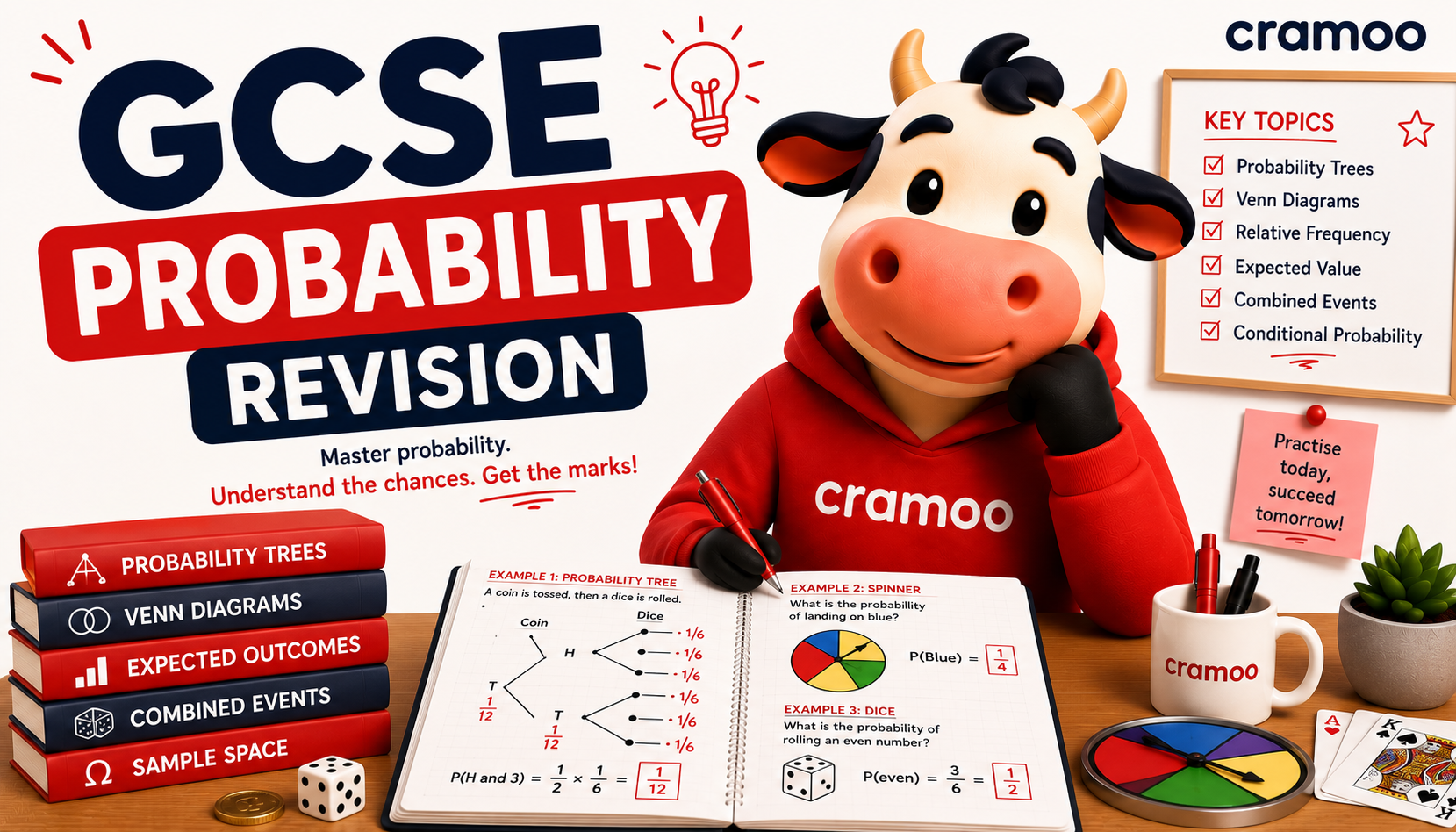
GCSE Probability Revision
Master GCSE Probability with our guide covering scale basics, tree diagrams, Venn diagrams, and independent events to help you ace your Maths exams.
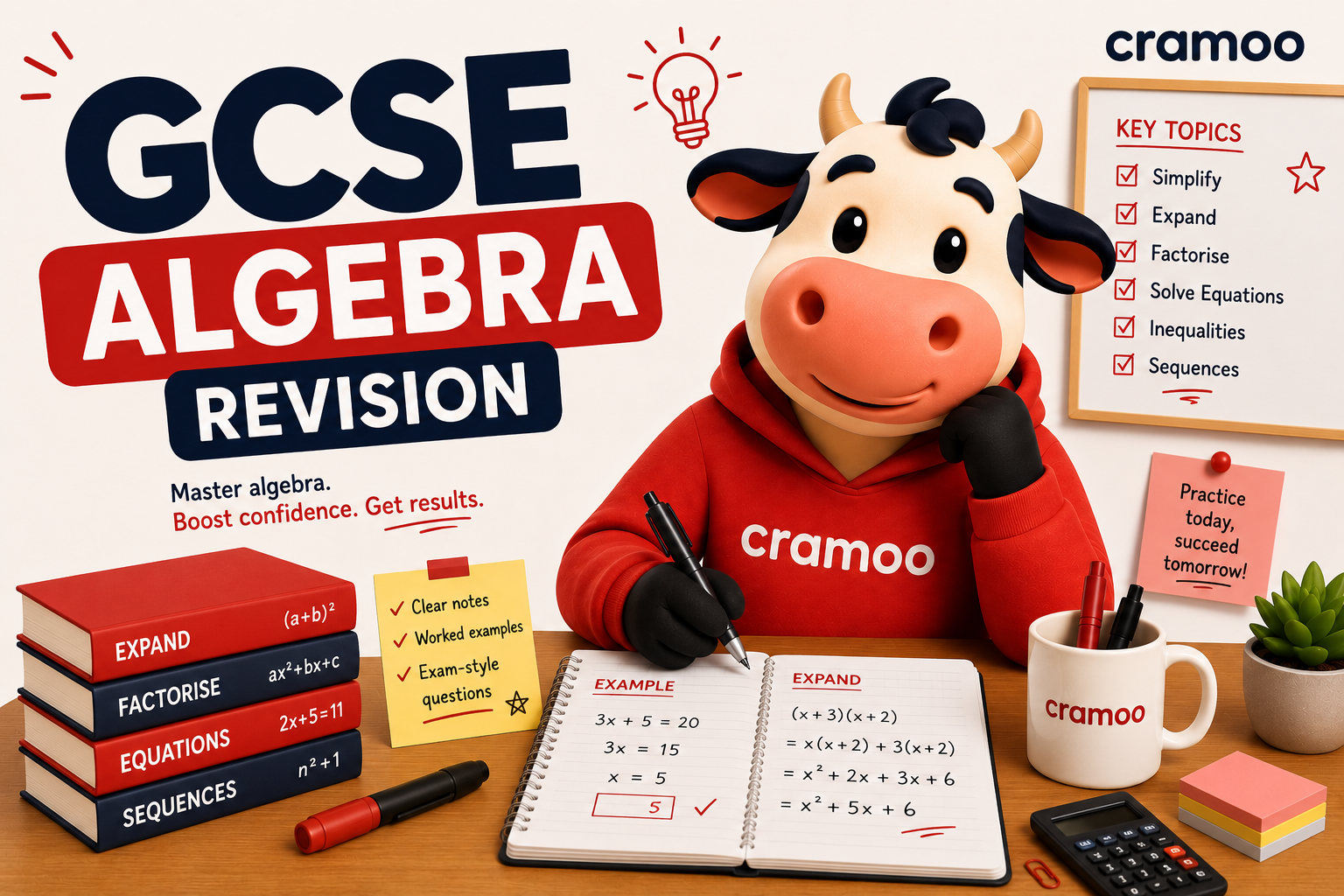
GCSE Algebra Revision
Learn how to master GCSE Algebra revision with this guide covering simplifying expressions, solving equations, quadratics, and sequences to boost your maths grade.
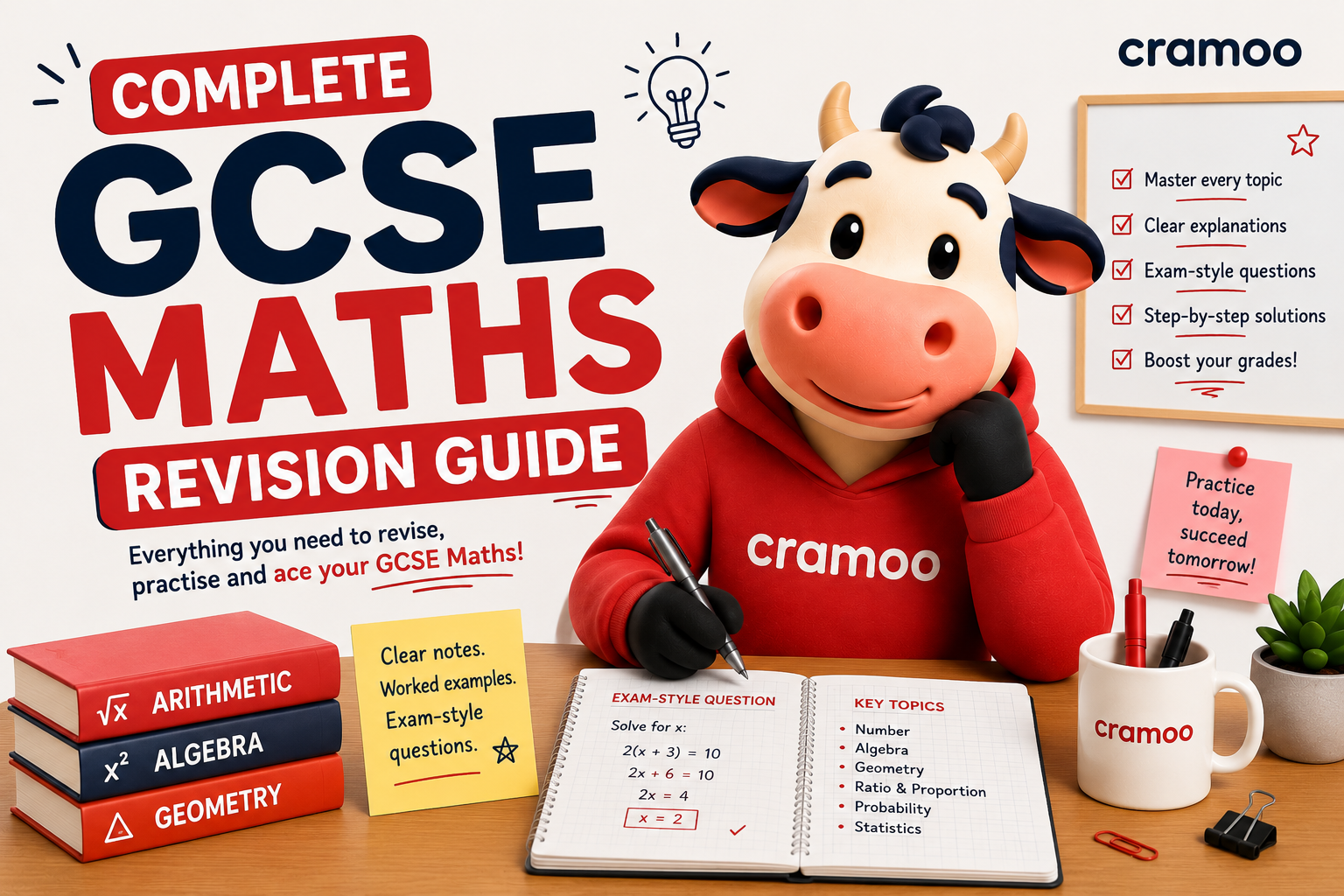
Complete GCSE Maths Revision Guide
Master your exams with this complete GCSE Maths revision guide. We break down the syllabus, provide proven study methods, and show you how to tackle past papers.