
GCSE Revision Checklist
A master GCSE revision checklist is essential for staying organised. Learn how to break down your subjects, track your progress, and use active recall effectively.
GCSE Revision Checklist
Staying organised is often the hardest part of Year 11. With up to ten subjects to manage, each containing dozens of topics, it is easy to feel overwhelmed. A well-structured GCSE revision checklist acts as your roadmap, ensuring you do not miss a single niche topic or lose time on things you already know fluently.
This guide provides a framework for building your own master checklist and explains how to use it to drive your grades upward.
Why You Need a Master Checklist
Most students approach GCSE revision by grabbing a textbook and reading from page one. This is inefficient. Without a checklist, you might spend three hours revising 'Cell Biology' because you enjoy it, while completely ignoring 'Organic Chemistry' because it feels difficult.
A checklist forces you to look at the entire specification. It highlights the gaps in your knowledge and gives you a sense of accomplishment as you tick off completed sessions. When you see your progress visually, exam stress becomes much more manageable.
How to Build Your GCSE Revision Checklist
The first step is gathering the correct information. You should not rely on memory to decide what is on the exam. Follow these steps to build an accurate list:
- Find the Specification: Go to the website of your exam board (AQA, Edexcel, OCR, or WJEC). Search for your specific subject and download the 'Specification' or 'Syllabus' document. This is the exact list of everything the examiner can ask you.
- Break it Down: Do not just write 'History' as a checklist item. Break it down into modules, such as 'Medicine Through Time' or 'Weimar and Nazi Germany'. Then, break those modules into specific events or themes.
- Use the RAG System: Use Red, Amber, and Green to code your list. Red means you have no idea what the topic is. Amber means you understand it but cannot answer an exam question yet. Green means you are confident and can explain it to someone else.
Core Subjects Checklist Example
To help you get started, here is how you might structure the checklists for the core subjects. You can find more detailed breakdowns in our subject hubs.
GCSE English Language and Literature
English is less about 'facts' and more about 'skills'. Your checklist should reflect the tasks you need to master:
- Language Paper 1: Creative reading and descriptive writing.
- Language Paper 2: Viewpoints, perspectives, and non-fiction comparison.
- Literature: Quotes for key characters in your Shakespeare play, themes in your 19th-century novel, and the context of your poetry anthology.
- Analysis Skills: Identifying metaphors, personification, and structural shifts.
GCSE Mathematics
Maths checklists are highly satisfying because you can clearly define what you know. Group your checklist by these five main areas:
- Number: Fractions, percentages, decimals, and ratio.
- Algebra: Solving equations, factorising, and sequences.
- Geometry: Trigonometry, Pythagoras' theorem, and circle theorems.
- Statistics: Probability, mean/median/mode, and sampling.
- Problem Solving: Applying multiple concepts to one 'long' question.
GCSE Science (Combined or Triple)
Science carries a massive amount of content. Ensure your checklist includes the 'Required Practicals' as these often form a large chunk of the marks. For Biology, Chemistry, and Physics, ensure you have listed every formula you need to memorise and every cycle (like the Carbon Cycle) you need to draw.
Using Your Checklist with Active Recall
A checklist is only useful if you use it alongside effective revision tips. Once you have identified an 'Amber' or 'Red' topic on your list, you need to move it to 'Green'.
Instead of just reading your notes, use active recall. This involves testing yourself without looking at the material. You could create a free deck of digital flashcards for the specific topic you just ticked off. Once you can answer every card in that deck three times in a row, you can officially mark that topic as complete on your checklist.
Managing Your Time
A checklist tells you what to study, but a GCSE Revision Timetable tells you when to study it.
On a Monday, you might look at your checklist and see that 'Simultaneous Equations' is marked as Red. You then schedule a 45-minute block in your timetable for that specific task. This targeted approach is far more effective than just sitting down to 'do some Maths'.
Refining the List as Exams Approach
As you get closer to May and June, your checklist should evolve. Early in the year, your list focuses on understanding content. In the final month, your checklist should focus on exam technique.
Add these items to your late-stage checklist:
- Completed at least three full past papers under timed conditions.
- Reviewed the mark schemes to see exactly where marks are awarded.
- Memorised the specific 'command words' used by your exam board (e.g., the difference between 'Describe' and 'Explain').
If you find yourself struggling to keep track of all your physical handouts, you can upload your notes to a digital platform to keep everything in one place. This makes it much easier to refer back to your checklist while you are on the move.
The Psychology of the Tick
Never underestimate the power of ticking a box. GCSEs are a marathon, and it is easy to feel like you are making no progress. By using a granular checklist, you give yourself daily wins. Each tick represents a small step toward your target grades. For more detailed support on specific units, check out our various study guides tailored to the current UK curriculum.
Using a GCSE revision checklist transforms your preparation from a chaotic scramble into a professional, organised operation. It ensures you walk into the exam hall knowing that nothing on that paper will be a surprise.
Frequently asked questions
Related reading
GCSE Grade Boundaries Explained
Understand how GCSE grade boundaries work, why they change every year, and how to use past boundaries to track your progress and aim for a Grade 9.
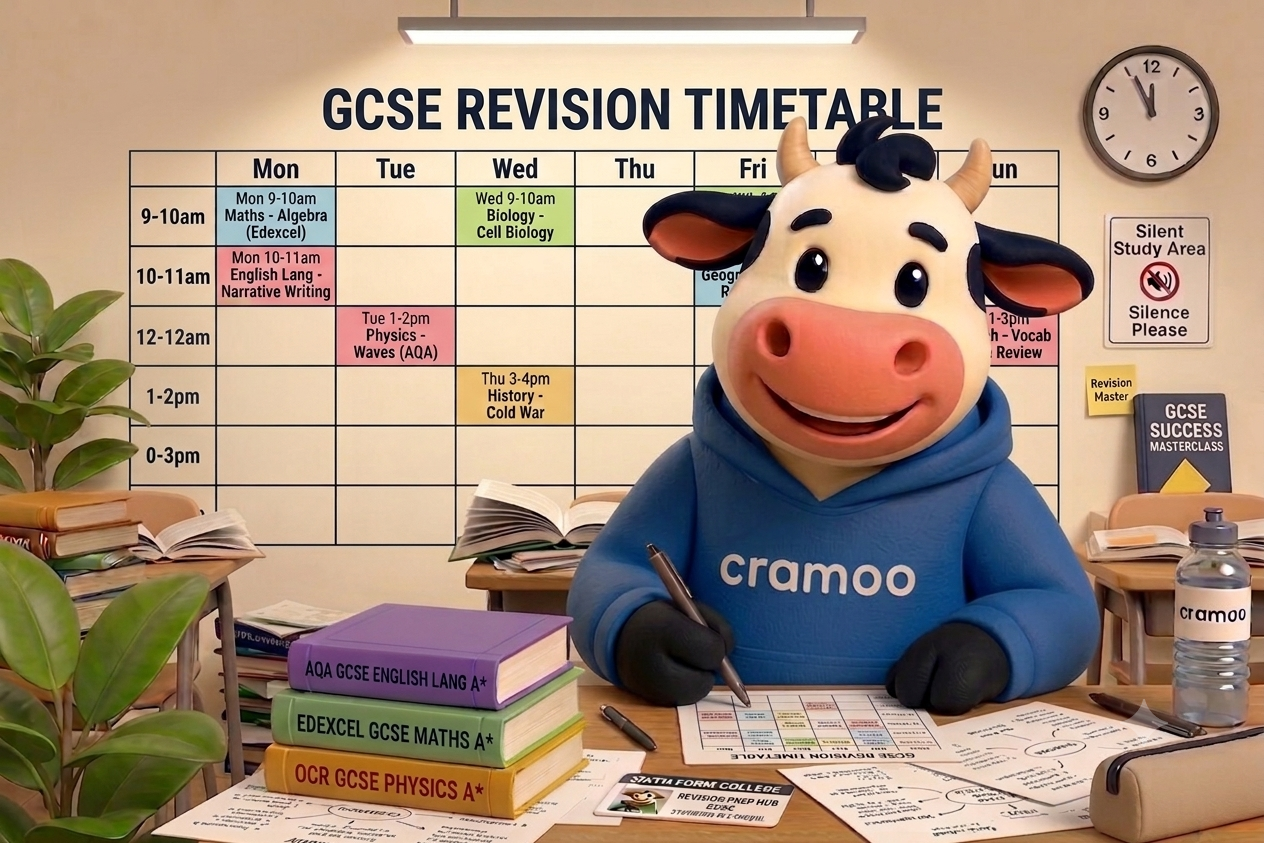
GCSE Revision Timetable
A GCSE revision timetable is more than just a calendar. It is a strategic plan that ensures you cover every topic before exam day while staying balanced and stress-free.
The Complete GCSE Revision Guide
Revision is not just about reading textbooks. This guide covers how to use active recall, past papers, and effective planning to ace your GCSE exams.
How to Revise for GCSE Exams
Learn how to revise for GCSE exams using evidence-based techniques like active recall and spaced repetition to improve memory retention and boost your grades.