
GCSE Physics Equation Sheet: What to Learn and What Is Given
Struggling with GCSE physics equations? Learn which formulas are given in the exam, which ones you must memorise, and how to use them to bag full marks.
Physics is often seen as a maths exam in disguise. For many students, the biggest hurdle isn't understanding how a motor works or why stars collapse, but knowing which formula to use and when. The rules regarding the GCSE physics equations sheet have shifted recently, and staying on top of what you need to memorise versus what is handed to you on a plate is essential for exam success.
Whether you are studying AQA, Edexcel, or OCR, you will be expected to recall a specific set of equations while being provided with others. This guide breaks down how to handle these formulas and how to apply them to those tricky calculation questions.
The Current State of the Equation Sheet
In recent years, exam boards have provided a more comprehensive equation sheet as a support measure. However, you should not rely on this as a safety net. Firstly, the Department for Education often reviews these arrangements. Secondly, even if the formula is right in front of you, you still need to know what the symbols mean and how to rearrange them.
Most GCSE specifications divide equations into two categories: those you must recall from memory and those provided on the data sheet. If you are aiming for a Grade 7 or above, you should aim to memorise all of them. Searching through a sheet during a timed exam wastes precious minutes that could be spent on the difficult 6-mark questions.
Equations You Must Memorise
There are several foundational formulas that frequently appear in Paper 1 and Paper 2. You should treat these as non-negotiable parts of your GCSE revision.
Speed, Distance, and Time
This is the most basic calculation, but it is the one students most often get wrong by not checking units. Equation: $s = vt$ (Distance = speed $\times$ time)
- Units: Distance in metres (m), speed in metres per second (m/s), time in seconds (s).
- Common Trap: The exam might give you time in minutes. Always convert to seconds by multiplying by 60 before plugging it into the formula.
Weight and Gravitational Field Strength
Equation: $W = mg$ (Weight = mass $\times$ gravitational field strength)
- Units: Weight in Newtons (N), mass in kilograms (kg).
- Tip: Remember that mass is constant regardless of where you are, but weight changes depending on gravity. On Earth, $g$ is usually taken as 9.8 N/kg.
Work Done and Energy
Equation: $W = Fs$ (Work done = force $\times$ distance)
- Units: Work done in Joules (J), force in Newtons (N), distance in metres (m).
- Context: This describes the energy transferred when a force moves an object.
Using the Given Equation Sheet Effectively
Even when the sheet is provided, it is not always easy to use. The equations are often presented in a list without the names of the variables. For example, you might see $v^2 - u^2 = 2as$. If you don't know that $v$ is final velocity and $u$ is initial velocity, the sheet is useless.
When you get your exam paper, take a moment to look at the equation sheet. If there are formulas you struggled to remember, highlight them. When you hit a calculation question, follow these four steps to ensure you don't lose marks:
- List your variables: Write down what you know from the question (e.g., $F = 10N, a = 2m/s^2$).
- Identify the unknown: Write down what you are looking for (e.g., $m = ?$).
- Select the formula: Find the equation that contains all those variables.
- Substitute and Solve: Put the numbers in before you try to rearrange. This guarantees you at least one mark even if your final answer is wrong.
Worked Example: Calculating Kinetic Energy
Let's look at a typical question you might find in a GCSE Physics Revision Guide.
Question: A cyclist with a total mass of 80kg is travelling at a speed of 5m/s. Calculate the kinetic energy of the cyclist.
Step 1: Variables
- $m = 80kg$
- $v = 5m/s$
Step 2: Formula $E_k = 0.5 \times m \times v^2$
Step 3: Substitution $E_k = 0.5 \times 80 \times 5^2$
Step 4: Calculation $E_k = 0.5 \times 80 \times 25$ $E_k = 40 \times 25 = 1000J$
The "Squared" Trap: A common mistake is forgetting to square the velocity, or squaring the whole $0.5 \times m \times v$ part. Only the velocity is squared.
Strategies for Memorising Formulas
Since many GCSE physics equations are not provided, you need a strategy to lock them into your long-term memory. Rote learning rarely works for everyone, so try these active methods instead:
The Flashcard Method
Create physical or digital cards. On one side, write the name of the equation (e.g., "Power in a circuit"). On the other side, write the formula ($P = VI$) and the units for each part. Use these during your GCSE revision timetable sessions for five minutes every day.
Formula Triangles (Use with Caution)
Triangles can help you rearrange simple three-variable equations. For $F = ma$, $F$ goes at the top, and $m$ and $a$ go at the bottom. While helpful, they don't work for more complex formulas like kinetic energy or elastic potential energy. It is better to learn the algebraic skill of rearranging.
Unit Analysis
If you forget the formula for pressure, look at the units. Pressure is measured in Pascals, which is the same as Newtons per square metre ($N/m^2$). This tells you that Pressure = Force (Newtons) divided by Area ($m^2$).
The Role of Units and Conversions
You can do the maths perfectly and still get the wrong answer if you ignore units. Physics examiners love to give you values in non-standard units to see if you are paying attention. Before you start any calculation, check for these common units that need converting:
- Kilometres (km) to Metres (m): Multiply by 1,000.
- Grams (g) to Kilograms (kg): Divide by 1,000.
- Milliseconds (ms) to Seconds (s): Divide by 1,000.
- Minutes to Seconds: Multiply by 60.
Write the converted number clearly on the exam paper so the examiner can follow your logic. Even if you make a mistake later, showing a correct conversion can sometimes earn a mark.
Practical Tips for Exam Day
When you sit down for your physics paper, your first task should be a "brain dump." If there are two or three equations you find particularly hard to remember, write them down at the top of the answer booklet as soon as the invigilator says you can start. This clears your head and reduces anxiety during the rest of the exam.
Always bring a calculator you are familiar with. Ensure it is not in 'radian' mode if you are doing trigonometry-based physics questions (like resolving forces), although most GCSE physics is done in degrees. Check your subject hubs for specific requirements for your exam board, as some may have slight variations in the required practicals that link to these equations.
By mastering the equations, you aren't just learning numbers; you are learning how the physical world interacts. With consistent practice and smart revision tips, these formulas will become second nature.
Frequently asked questions
Related reading
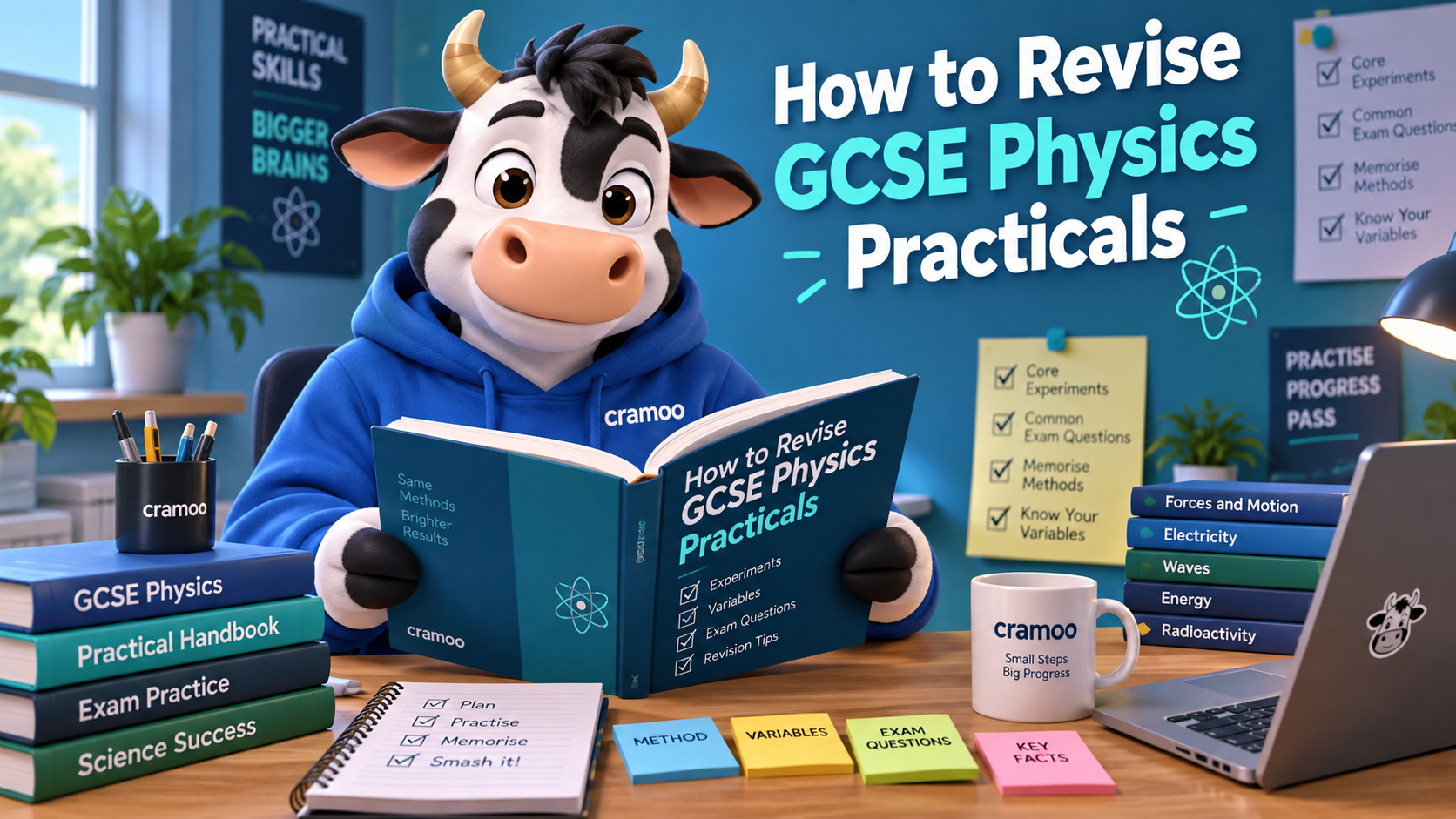
How to Revise GCSE Physics Practicals
Struggling with physics practicals? This guide breaks down the core experiments, common exam questions, and the best ways to memorise methods and variables.
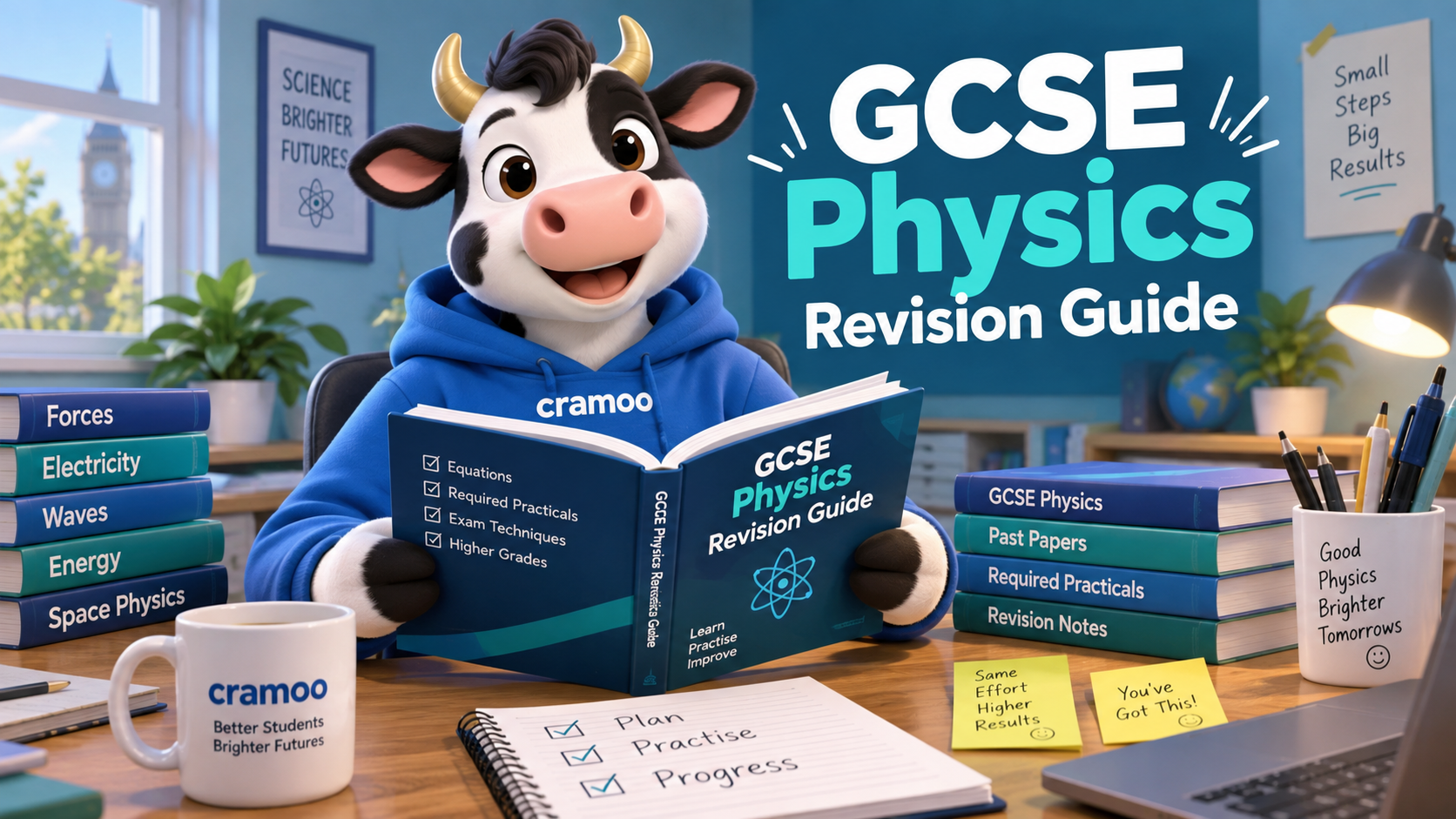
GCSE Physics Revision Guide
A comprehensive guide to GCSE Physics revision, covering essential equations, required practicals, and effective study techniques for UK students.
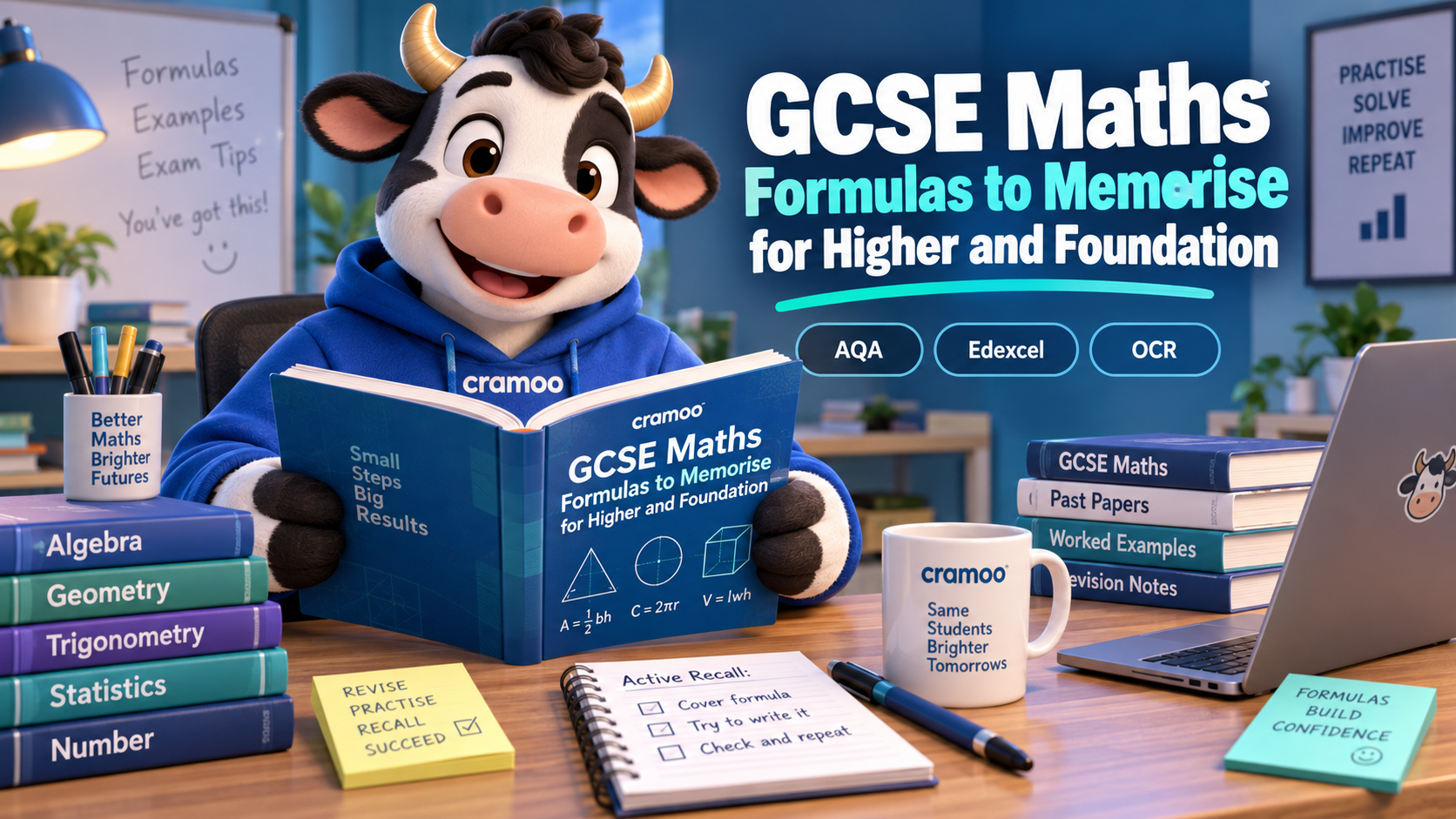
GCSE Maths Formulas to Memorise for Higher and Foundation
A comprehensive breakdown of all GCSE maths formulas you must memorise for AQA, Edexcel, and OCR exams, featuring worked examples and active recall tips.
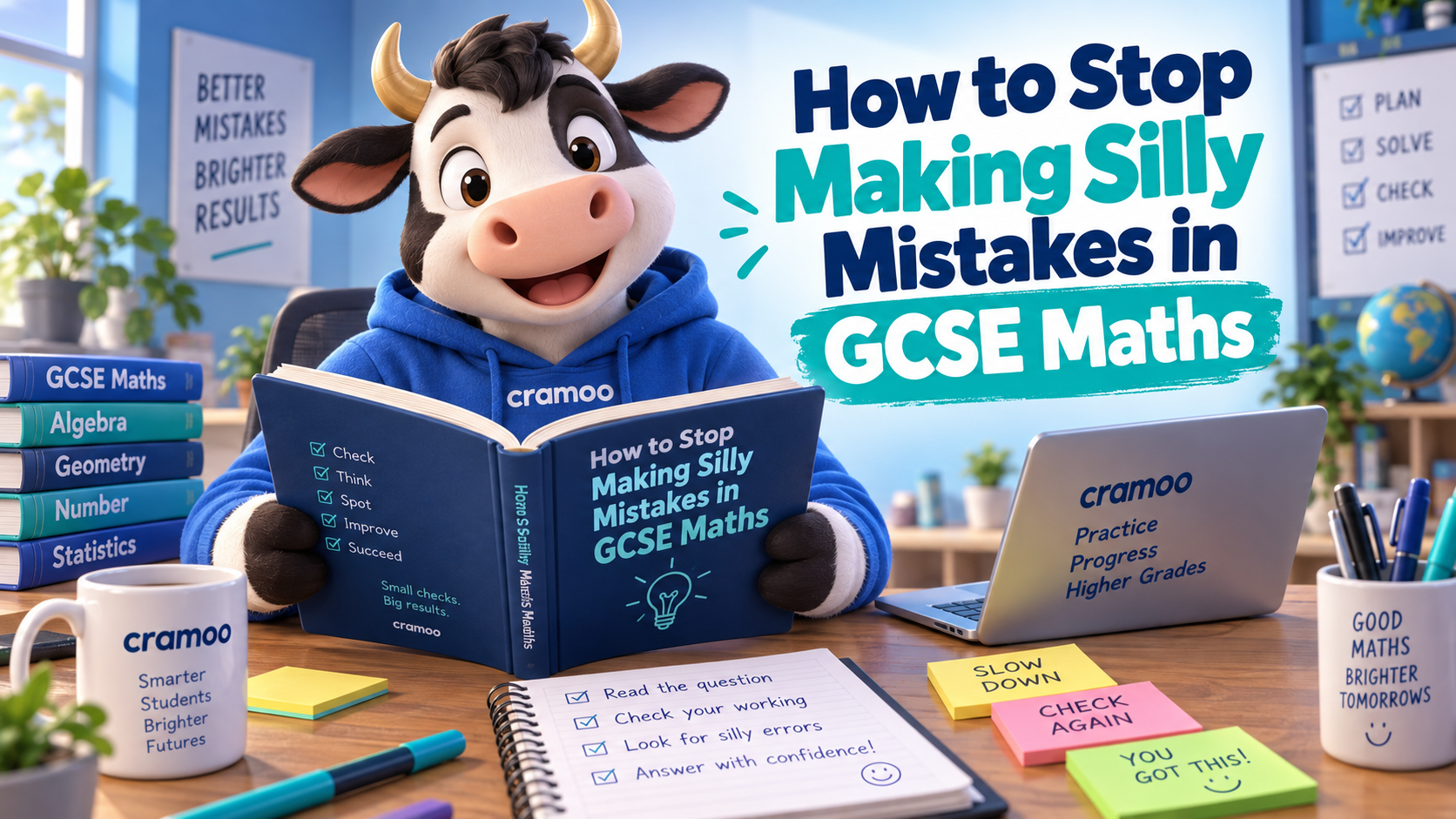
How to Stop Making Silly Mistakes in GCSE Maths
Tired of losing marks to silly errors in your GCSE Maths papers? Discover the specific techniques used by top students to catch mistakes before the timer runs out.