
A-Level Exam Boards Explained
Which board you sit changes your specification, papers and mark schemes. Here is how to find out and why it matters.
Your A-Level in Biology is not quite the same as your friend's A-Level in Biology at another school. The subject content overlaps heavily, but the exam board sets the specification, writes the papers, decides the assessment structure and publishes the mark schemes. Knowing which board you sit is essential, because revising with the wrong board's material wastes hours.
The Main A-Level Exam Boards
AQA is the largest board in England and offers the widest range of A-Level subjects. Its papers are known for clear structure and heavy use of application questions in the sciences.
Pearson Edexcel is the second-largest and is widely used for Maths, the sciences and Business. Edexcel Maths in particular has a very consistent question style, which makes past papers extremely predictable revision material.
OCR is popular for the sciences, Computer Science and Classics. It often offers two routes in a subject — for example OCR Biology A and Biology B (Advancing Biology) — which are assessed quite differently, so check which one your school teaches.
WJEC/Eduqas is the Welsh board; WJEC serves Wales and Eduqas offers the same subjects to centres in England.
CCEA is used in Northern Ireland.
Cambridge International (CIE) is used by international schools and some independent schools in the UK. Its papers and grading are separate from the domestic boards.
Why the Board Matters
- Specification content differs. Optional topics, set texts and case studies vary. Learning the wrong option is a genuine risk.
- Paper structure differs. Number of papers, length, and the balance of multiple-choice, short answer and extended response are all board-specific.
- Mark schemes differ. Two boards can award the same content differently, especially in essay subjects where level-of-response grids vary.
- Required practicals and set works differ in sciences, English and the arts.
How to Find Out Which Board You Sit
- Ask your subject teacher — the quickest route.
- Check the front of your textbook; most are board-branded.
- Look at your statement of entry, which lists the board and the subject code for every paper.
- Check a past exam paper you have been given in class — the board's logo and subject code appear on the front.
Note that you can sit different boards for different subjects. It is entirely normal to do AQA Psychology and Edexcel Maths at the same school.
Getting the Right Past Papers
Every board publishes past papers, mark schemes and examiner reports free on its website. Three things to check before you print anything:
- The board — obviously.
- The subject code — for example Edexcel Maths 9MA0, or AQA Biology 7402.
- The specification version — specifications are periodically reformed, and pre-reform papers can contain content you no longer study or omit content you do.
Examiner reports are the most underused resource on those sites. They tell you exactly where students lost marks on that paper, which is effectively a list of the traps in next year's version. Read How A-Levels Are Marked for more on how those reports are produced.
Is One Board Easier?
Not in any way that helps you. Boundaries are set per board and per paper through comparable outcomes, so an A from AQA and an A from OCR represent the same standard. If one board's paper is harder in a given year, its boundaries drop accordingly — as explained in A-Level Grade Boundaries Explained.
What does differ is style. Some students find Edexcel's structured Maths questions suit them; others prefer OCR's more synoptic approach. You do not usually get to choose, so the practical response is simply to learn your board's style thoroughly.
Using Other Boards' Papers
Once you have exhausted your own board's papers, other boards' questions can still be useful for topic practice — particularly in Maths and the sciences where the underlying content is similar. Two rules:
- Use them for topic drills, never as a mock of the real thing.
- Check the content is on your specification before you spend an hour on it.
Cross-board practice is a bonus, not a substitute.
Subject Notes by Board
- Maths: all boards assess Pure, Statistics and Mechanics, but question style differs noticeably. See the A-Level Maths hub.
- Biology, Chemistry, Physics: required practicals and data-analysis expectations are board-specific. Start with Biology, Chemistry or Physics.
- Psychology: AQA's approaches, issues and debates content is distinctive — see Psychology.
- Economics: essay weighting and data-response formats vary; check the Economics hub.
- English Literature: set texts and the balance of coursework are board-specific — see English Literature.
A Five-Minute Job Worth Doing Today
Write down each of your subjects, the board, and the subject code. Bookmark each board's past-paper page. Then check that every past paper already sitting in your revision folder actually matches. Students discover mismatches in June every year; finding it in October costs you nothing.
Once you have the right specification in front of you, turn it into a checklist with our A-Level Revision Checklist, and build flashcards from your notes with Cramoo.
More guides in the A-Level hub.
Frequently asked questions
Related reading
A-Level English Literature: Building a Quote Bank
Mastering A-Level English Literature quotes requires more than just memorisation. Learn how to build a strategic quote bank that secures top marks in your exams.

A-Level Computer Science Theory: Data Structures and Algorithms
A deep dive into essential A-Level computer science data structures and algorithms, covering everything from linked lists to Big O notation for UK students.
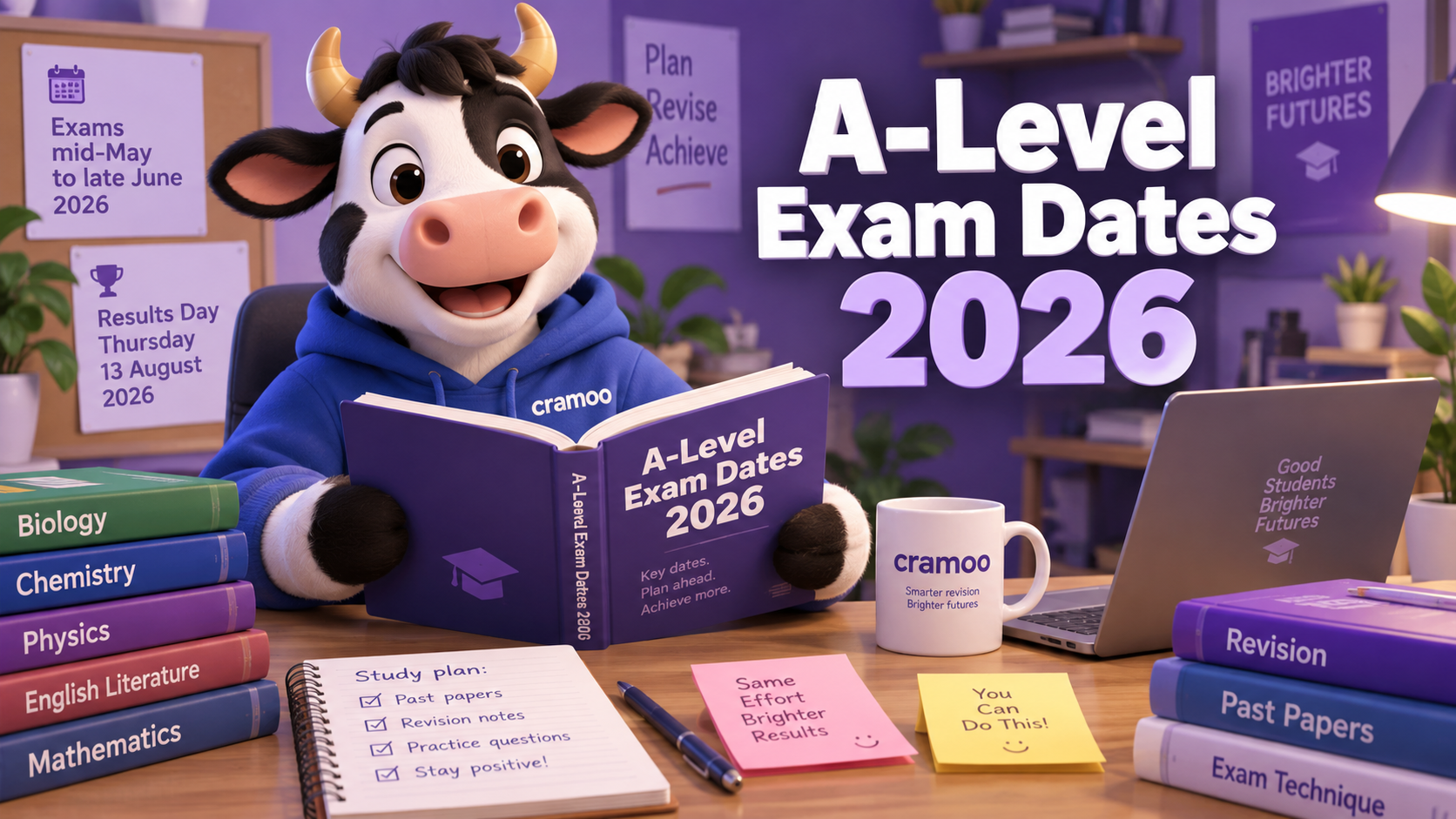
A-Level Exam Dates 2026
A-Level exams in 2026 are expected to run from mid-May to late June, with Results Day on Thursday 13 August 2026.
The A-Level Revision Checklist
Turn a 60-page specification into a list of finishable jobs with this A-Level revision checklist.